

Protecting Your Child’s Future with Critical Illness Insurance

When we think about protecting our children, most of us picture car seats, helmets, or saving for education. But what about protecting them financially if they face a serious health condition? While it’s not something any parent or grandparent wants to imagine, children can face serious illnesses. Children’s critical illness insurance is designed to provide families with financial support during those tough times.

Understanding Children’s Critical Illness Insurance

Critical illness insurance provides a lump-sum payment if the insured person is diagnosed with a covered illness. This money can be used however the family needs—whether that’s to cover medical treatments not included in provincial health coverage, replace income while taking time off work, or pay for travel to specialized hospitals. Unlike traditional health insurance, which reimburses medical costs, this coverage gives you flexibility to decide how best to use the funds.

Covered conditions can include serious illnesses such as cancer, heart conditions, organ transplants, or neurological disorders. While children are generally healthy, these conditions can and do occur, and the financial strain can be significant. This insurance helps soften that impact by providing families with resources when they need them most.

Why Families Consider This Coverage

Parents and grandparents often ask: “Why insure a child if they don’t have income to protect?” The answer lies in peace of mind and flexibility. If a child becomes seriously ill, one or both parents may need to take unpaid leave from work to be by their side. Having this coverage means the family can focus on supporting their child rather than worrying about finances.

For example, imagine a parent who has to step away from work for several months to care for their child during treatments. Without financial support, this could create major stress for the household. With a payout from children’s critical illness insurance, the family can cover mortgage payments, extra childcare for siblings, or the cost of travelling to a specialized hospital.

In some cases, policies may even allow children to convert their coverage into adult policies later in life, offering long-term protection. This means the child may carry their coverage into adulthood without worrying about requalifying based on health changes.

The Cost of Children’s Critical Illness Insurance

The cost of children’s critical illness insurance is generally lower than coverage for adults because kids are younger and usually healthy. Premiums depend on factors such as the child’s age, the amount of coverage, and the insurance provider.

For many families, the monthly cost is manageable, often similar to what you might spend on a family outing or streaming subscription. This affordability makes it accessible for parents and grandparents who want to add another layer of protection without straining their budget.

Key Benefits for Families

The biggest benefit is financial breathing room. When a child faces a major health issue, parents should not have to choose between work and caring for their child. The payout can cover lost income, extra childcare for siblings, travel expenses, or alternative treatments.

Another benefit is that securing coverage while a child is healthy makes it easier for them to have insurance as adults, even if health challenges arise later. It’s a way of ensuring future insurability, which can be especially valuable if there’s a family history of medical conditions.

Does Your Policy Include Your Child?

Some parents assume their own critical illness insurance will extend to their children, but that is rarely the case. These policies typically only cover the insured adult. If you want protection for your child, it usually requires a separate policy or rider (an add-on to your own policy). Reviewing your existing insurance with an advisor can help you understand what’s included and where gaps may exist.

Additional Ways to Protect Your Child

Children’s critical illness insurance is one tool among many. Parents and grandparents can also consider health savings, disability coverage for themselves, or even education savings plans.

Whole life insurance for children is another option worth exploring. This type of coverage not only provides lifelong protection but can also build cash value over time. The accumulated value can be accessed later in life to help with education costs, a first home purchase, or other needs. Securing whole life insurance early can lock in lower premiums while ensuring your child has guaranteed coverage, regardless of future health changes.

A balanced approach might include combining children’s critical illness insurance for short-term protection with whole life insurance for long-term stability. Together, these tools can support both immediate financial needs in case of illness and long-term goals for your child’s future.

Facing the possibility of a child’s illness is never easy. But preparing ahead with the right insurance can ease financial stress if the unexpected happens. It allows families to focus on what truly matters: giving their child the best chance at recovery and support.

By considering children’s critical illness insurance, along with other tools such as whole life insurance, you can take meaningful steps to safeguard your child’s well-being—both now and in the future.

This is for informational purposes only and does not constitute financial, legal, or tax advice. Always consult a qualified professional regarding your specific situation. We are not responsible for any actions taken based on this content.

What is Critical Illness Insurance?

Nowadays, people survive serious medical issues such as cancer, a heart attack, or a stroke. And while this is good news if a critical
illness happens to you – your recovery may come with costs that you don’t have the money to cover.

This is where critical illness insurance can play a crucial role. In this article, we’ll explain:

  • What critical illness insurance is.
  • What you can use the money from a critical illness insurance payout for.
  • How you can get critical illness insurance.

What is critical illness insurance?

A critical illness policy is designed to help you pay the costs associated with a serious medical issue such as cancer, a stroke or a
heart attack.  With critical illness insurance, your insurance company will issue you a lump-sum payment once the waiting period has passed.

Critical illness insurance can help you pay for costs that aren’t covered by other health plans or disability insurance.

What can I use the money from critical illness insurance for?

With a critical illness lump-sum payment, there are no restrictions on what you can use the money for. You can choose to use the money
to:

  • Pay down debt or cover costs such as travel to and from your treatment.
  • Cover lost income for you if you cannot work. This is especially important if you are self-employed.
  • Pay for a caregiver or lost wages if your spouse takes time off work to be a caregiver.
  • Cover renovations on your house that are necessary due to your illness.
  • Cover medical treatments and medications not covered by a government or private health plan.

Being able to spend your critical illness insurance lump-sum payment freely takes a lot of stress off you and your family.

How do I get critical illness insurance?

We can help you get critical illness insurance.  If you’re interested in critical illness insurance, these are the steps you’ll need to follow:

  1. Think about why you want critical illness insurance and what kind of coverage you need.
  2. Book an appointment to speak to us. Apply for coverage.
  3. We’ll let you know when you’re approved and deliver your policy.

If you do get any of the illnesses listed in your policy, contact us, and we’ll guide you through the steps you need to file a claim. After your claim is approved, we’ll let you know when to expect your lump-sum payment.

Contact us!

It can be scary to think about getting ill, but critical illness insurance can help put your mind at ease that you’ll have the financial
resources you need. Reach out to us today to learn more!

Insurance Planning for Incorporated Professionals
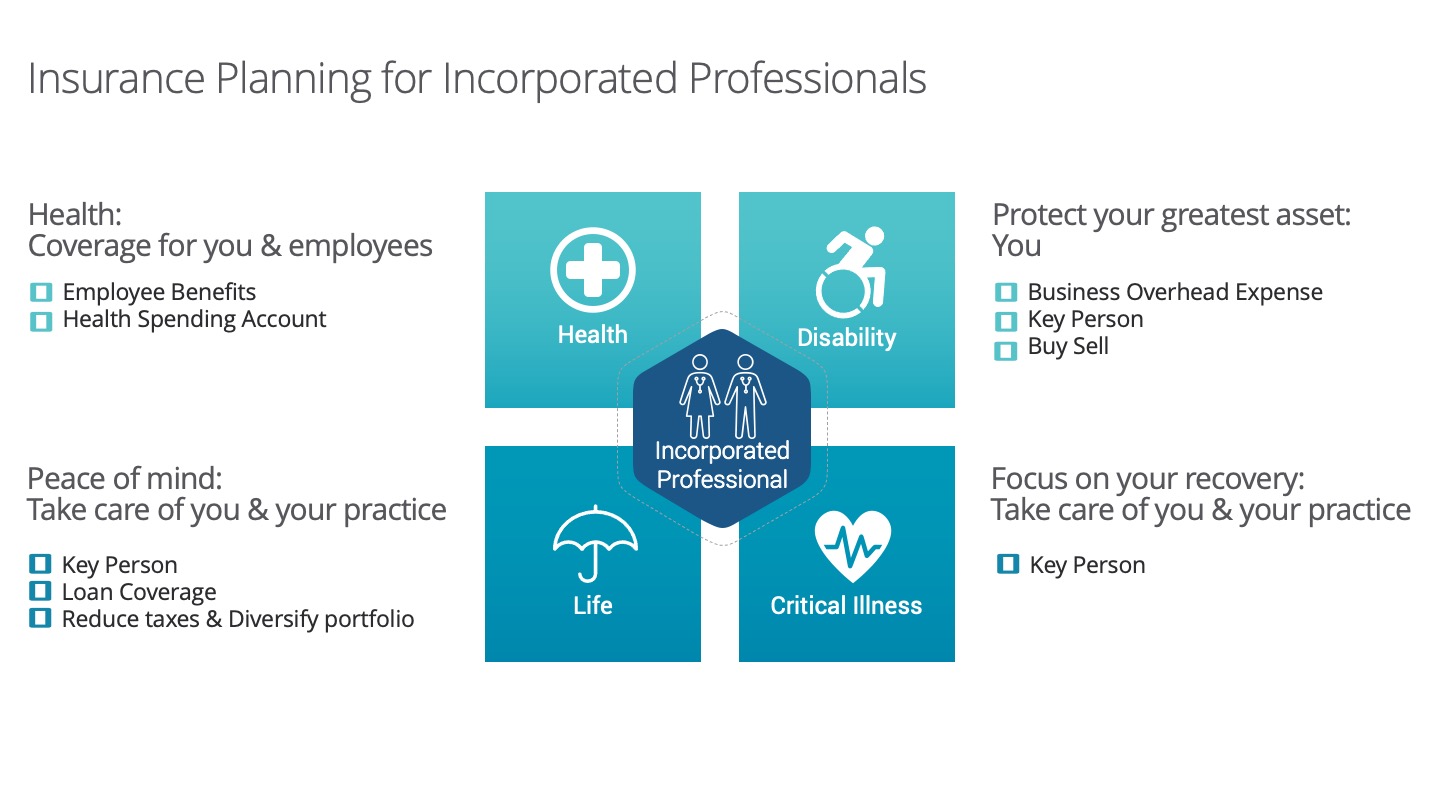
For incorporated professionals, making sure your practice is financially protected can be overwhelming. Incorporated professionals face a unique set of challenges when it comes to managing risk. Insurance can play an important role when it comes to reducing the financial impact on your practice in the case of uncontrollable events such as disability, or critical illness. This infographic and article address the importance of corporate insurance.

The 4 areas of insurance a incorporated professional should take care of are: 

  • Health 

  • Disability 

  • Critical Illness 

  • Life

Health: We are fortunate in Canada, where the healthcare system pays for basic healthcare services for Canadian citizens and permanent residents. However, not everything healthcare related is covered, in reality, 30% of our health costs* are paid for out of pocket or through private insurance such as prescription medication, dental, prescription glasses, physiotherapy, etc.

For incorporated professionals, offering employee health benefits make smart business sense because health benefits can form part of a compensation package and can help retain key employees and attract new talent.

For incorporated professionals that are looking to provide alternative health plans in a cost effective manner, you may want to consider a health spending account.

Disability: Most people spend money on protecting their home and car, but many overlook protecting their greatest asset: their ability to earn income. Unfortunately one in three people on average will be disabled for 90 days or more at least once before the age of 65.

Consider the financial impact this would have on your practice if you or a key employee were to suffer from an injury or illness. Disability insurance can provide a monthly income to help keep your practice running.

Business overhead expense insurance can provide monthly reimbursement of expenses during total disability such as rent for commercial space, utilities, employee salaries and benefits, equipment leasing costs, accounting fees, insurance premiums for property and liability, etc.

Key person disability insurance can be used to provide monthly funds for you or key employee while they’re disabled and protect the business from lost revenue while your business finds and trains an appropriate replacement.

Critical Illness: For a lot of us, the idea of experiencing a critical illness such as a heart attack, stroke or cancer can seem unlikely, but almost 3 in 4 (73%) working Canadians know someone who experience a serious illness. Sadly, this can have serious consequences on you, your family and business, with Critical Illness insurance, it provides a lump sum payment so you can focus on your recovery.

Key person critical illness insurance can be used to provide funds to the practice so it can supplement income during time away, cover debt repayment, salary for key employees or fixed overhead expenses.

Buy sell critical illness insurance can provide you with a lump sum payment if your business partner or shareholder were to suffer from a critical illness. These funds can be used to purchase the shares of the partner, fund a buy sell agreement and reassure creditors and suppliers.

Life: For an incorporated professional, not only do your employees depend on you for financial support but your loved ones do too. Life insurance is important because it can protect your practice and also be another form of investment for excess funds.

Key person life insurance can be used to provide a lump sum payment to the practice on death of the insured so it can keep the business going until you an appropriate replacement is found. It can also be used to retain loyal employees by supplying a retirement fund inside the insurance policy.

Loan coverage life insurance can help cover off any outstanding business loans and debts.

Reduce taxes & diversify your portfolio, often life insurance is viewed only as protection, however with permanent life insurance, there is an option to deposit excess funds not needed for operations to provide for tax-free growth (within government limits) to diversify your portfolio and reduce taxes on passive investments.  

Talk to us to make sure you and your practice are protected.