Truity Financial
  • Services
    • Individuals & Families
      • Financial Advice
      • Insurance Planning
      • Retirement Planning
      • Estate Planning for Young Families
      • Estate Planning for Retirees and Mature Families
    • Business Owners
      • Financial Advice
      • Insurance Planning
      • Estate Planning for Business Owners
      • Succession Planning
      • Group Health Benefits
      • Group Retirement Benefits
      • Individual Pension Plan
      • Health Spending Account
    • Incorporated Professionals
      • Financial Advice
      • Retirement Planning
    • Insurance
      • Disability Insurance
      • Critical Illness Insurance
      • Long Term Care
      • Mortgage Insurance
      • Life Insurance
      • Personal Life Insurance
      • Corporate Life Insurance
      • TRAVEL INSURANCE
    • Investment
      • Registered Education Savings Plan
      • Tax Free Savings Account
      • Registered Retirement Savings Plan
      • Registered Retirement Income Fund
      • Annuities
    • Group Benefits
      • Group Health Benefits
      • Group Retirement Benefits
    • Financial Advice
      • Financial Advice
      • Financial Advice for Business Owners
      • Financial Advice for Incorporated Professionals
    • Retirement Planning
      • Employees
      • Business Owners
      • Incorporated Professionals
    • Estate Planning
      • Young Families
      • Retirees and Mature Families
      • Business Owners
      • Estate Freeze
  • About
    • About
    • Suppliers
    • Privacy and Website Terms of Use
  • Resources
    • Financial Calculators
  • Blog
  • Contact
  • Search
  • Menu Menu
  • LinkedIn
  • Twitter
  • Facebook

Archive for category: Tax Free Savings Account

2025 Personal Year End Tax Tips

December 2, 2025/in Blog, Families, Family, financial advice, Financial Planning, Insurance, Investment, investments, Preparing for Retirement, rdsp, Registered Disability Savings Plan, Registered Education Savings Plan, Retirees, retirement, Retirement Savings, Tax Free Savings Account /by Truity Financial

brandableContent

The end of 2025 is approaching fast — and that means it’s time to get organized before tax season. By reviewing your finances now, you can take advantage of tax-saving opportunities before December 31 and start the new year with confidence.

This article covers four key areas of year-end tax planning for 2025:

  • Investment Considerations
  • Individuals & Employees
  • Families
  • Retirees

These simple strategies can help you keep more of what you earn and set yourself up for a smoother filing season in spring 2026.

Investment Considerations

Tax-Loss Selling

Selling investments in non-registered accounts that have lost value can offset taxable gains. Losses can be carried back three years or forward indefinitely. To ensure the loss applies for 2025 (or the prior three years), the transaction must settle within 2025. Be cautious about the “superficial loss” rule — if you or an affiliated person repurchase the same investment within 30 days, your loss will be denied and added to the cost base of the new shares.

Tax-Free Savings Account (TFSA)

The 2025 TFSA contribution limit is $7,000. If you’ve been 18 or older since 2009 and have never contributed, you can contribute up to $102,000 total by the end of 2025. If you plan to withdraw funds and re-contribute, make the withdrawal before year-end — new contribution room only opens on January 1, 2026.

Registered Retirement Savings Plan (RRSP)

You can contribute to your RRSP or spousal RRSP for the 2025 tax year until March 2, 2026. The maximum contribution limit for 2025 is $32,490, or 18% of your 2024 earned income, whichever is less. If your income is lower this year but expected to rise in 2026, consider making the contribution but deferring the deduction to a future year when it could save more tax.

Interest Deductibility

Focus on paying off debt with non-deductible interest first, such as personal loans or credit cards. Consider paying down non-deductible debts, such as credit cards or personal loans, before tackling deductible ones like investment or business loans.

Individuals & Employees

Income Timing

If you expect your income to drop in 2026 — for example, due to a job change, retirement, or taking time off — you may wish to defer some income or bonuses into next year. On the other hand, if you anticipate being in a higher bracket in 2026, consider receiving bonuses or selling appreciated investments before December 31, 2025.

Home Office Expenses

If you work from home, you may be eligible to claim a portion of home-related expenses like utilities, rent, or internet costs. Keep detailed records of your workspace and eligible receipts.

Employee Stock Options

For employees holding stock options, remember that the $200,000 annual vesting limit still applies for certain employers. If you plan to exercise or donate shares, review the timing to avoid triggering unnecessary tax under the new Alternative Minimum Tax (AMT) rules.

Company Cars and Mileage Logs

If your employer provides a company car, you can reduce taxable benefits by minimizing personal use or reimbursing your employer for operating costs. Keep a detailed mileage log — it’s one of the most effective ways to support your claim.

Families

First Home Savings Account (FHSA)

The FHSA continues to be a powerful savings tool for first-time homebuyers. You can contribute $8,000 per year, up to a lifetime limit of $40,000, with unused room carried forward. Contributions are tax-deductible, and qualifying withdrawals are tax-free when used to buy a first home.

Childcare Expenses

If you pay for daycare, camps, or certain boarding school costs so that you or your spouse can work or study, make sure these expenses are paid and receipted by December 31, 2025. The lower-income spouse should generally claim the deduction. Some provinces offer additional refundable childcare tax credits.

Registered Education Savings Plan (RESP)

RESPs help families save for children’s education. The government contributes a 20% Canada Education Savings Grant (CESG) on the first $2,500 contributed each year per child — up to $500 per year and a $7,200 lifetime maximum. If your child turned 15 in 2025 and hasn’t been an RESP beneficiary before, contribute at least $2,000 this year to preserve CESG eligibility for 2026 and 2027.

Registered Disability Savings Plan (RDSP)

Families supporting a loved one with a disability can contribute up to $200,000 over their lifetime to an RDSP. The government may provide matching Canada Disability Savings Grants (up to $3,500 annually) and Bonds (up to $1,000) depending on family income. Be sure to make 2025 contributions before year-end to maximize matching grants.

Consider making RESP and RDSP contributions before December 31 to receive government grants within the 2025 calendar year.

Caregiver

Family Caregiver Amount: If you support a dependent family member with a disability or illness, check if you qualify for this non-refundable credit.


Retirees

Registered Retirement Income Fund (RRIF)

Turning 71 this year? You are required to end your RRSP by December 31. You have several choices, including transferring your RRSP to a RRIF, cashing out your RRSP, or purchasing an annuity. Consult a professional about the tax implications of each option.

Pension Income Splitting

Are you 65 or older and receiving pension income? If your pension income is eligible, you can deduct a federal tax credit equal to 15% on the first $2,000 of pension income received, plus any provincial tax credits. If you don’t currently have any pension income, consider withdrawing $2,000 from a RRIF each year or using RRSP funds to purchase an annuity that pays at least $2,000 per year.

Canada Pension Plan (CPP)

If you’ve reached age 60, you may be considering applying for CPP. Keep in mind that if you do this, the monthly amount you’ll receive will be smaller. You don’t have to be retired to apply for CPP. Consult a professional to determine what makes the most sense for your situation.

Old Age Security (OAS)

If you’re 65 or older, enrolling in OAS is essential. If your income exceeds OAS thresholds, strategies like income splitting can help reduce clawbacks. You can defer OAS for up to 60 months, increasing your monthly payment by 0.6% for each month deferred. Planning ensures you maximize your benefits and optimize your retirement income.

Deferring OAS for up to 60 months after age 65 increases your monthly benefit by 0.6% per month (7.2% per year), up to a maximum of 36%.

Estate Planning Arrangements

Regularly reviewing your estate plan is essential to ensure it aligns with your objectives and complies with current tax laws. An annual review allows you to adjust for life changes and legal updates, keeping your plan effective. Additionally, exploring strategies to minimize probate fees can preserve more of your estate for your beneficiaries. Regularly examining your will ensures it remains valid and reflects your current wishes.

Certain trusts and bare trust arrangements now have new reporting obligations beginning in 2025, including identifying trustees and beneficiaries on a T3 return.

Proactive planning before December 31 can make a meaningful difference on your 2025 tax bill. Review your investment mix, make contributions on time, and explore credits that apply to your situation. Whether you’re investing, raising a family, or transitioning into retirement, small steps today can help you start 2026 in a stronger financial position.

If you’d like to review your personal situation or discuss these opportunities, reach out — now’s the time to plan ahead.


Sources:

  • CIBC Private Wealth. “2025 Year-End Tax Tips.” CIBC, 2025, https://www.cibc.com/content/dam/personal_banking/advice_centre/tax-savings/year-end-tax-tips-en.pdf
  • PricewaterhouseCoopers LLP. “Year-End Tax Planner 2025.” PwC Canada, 2025, https://www.pwc.com/ca/en/services/tax/publications/guides-and-books/year-end-tax-planner.html#checklists
  • Finance Canada. “Federal Budget 2025 Highlights.” Government of Canada, 2025, https://budget.canada.ca/2025/home-accueil-en.html

This content is for informational purposes only and does not constitute financial, legal, or tax advice. Always consult a qualified professional regarding your specific situation. We are not responsible for any actions taken based on this content.

https://truityfinancial.ca/wp-content/uploads/2025/12/2025-Year-End-Tax-Tips.png 700 1200 Truity Financial https://truityfinancial.ca/wp-content/uploads/2020/10/truityFinancialLogo.jpg Truity Financial2025-12-02 11:53:062025-12-02 11:53:062025 Personal Year End Tax Tips

TFSA vs RRSP 2025

January 31, 2025/in Blog, Investment, rrsp, Tax Free Savings Account /by Truity Financial

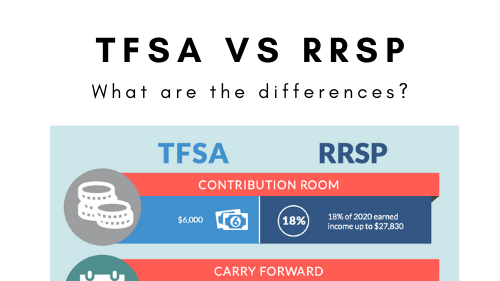
When looking to save money in a tax-efficient manner, Tax-Free Savings Accounts (TFSA) and Registered Retirement Savings Plans (RRSP) can offer significant tax benefits. To assist you in understanding the distinctions, we will compare the following:

  • The differences in deposits between TFSAs and RRSPs

  • The differences in withdrawals between TFSAs and RRSPs
brandableContent

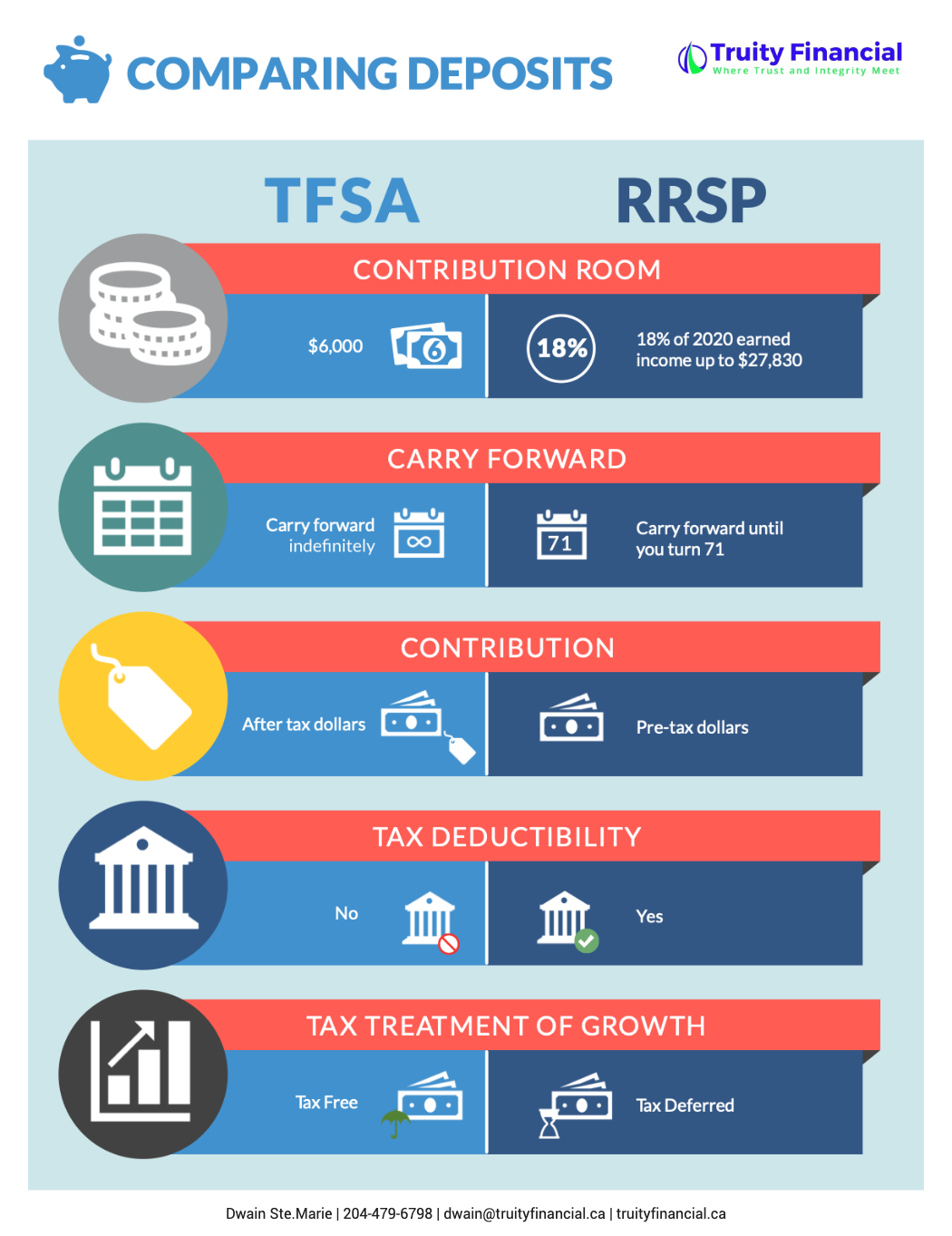
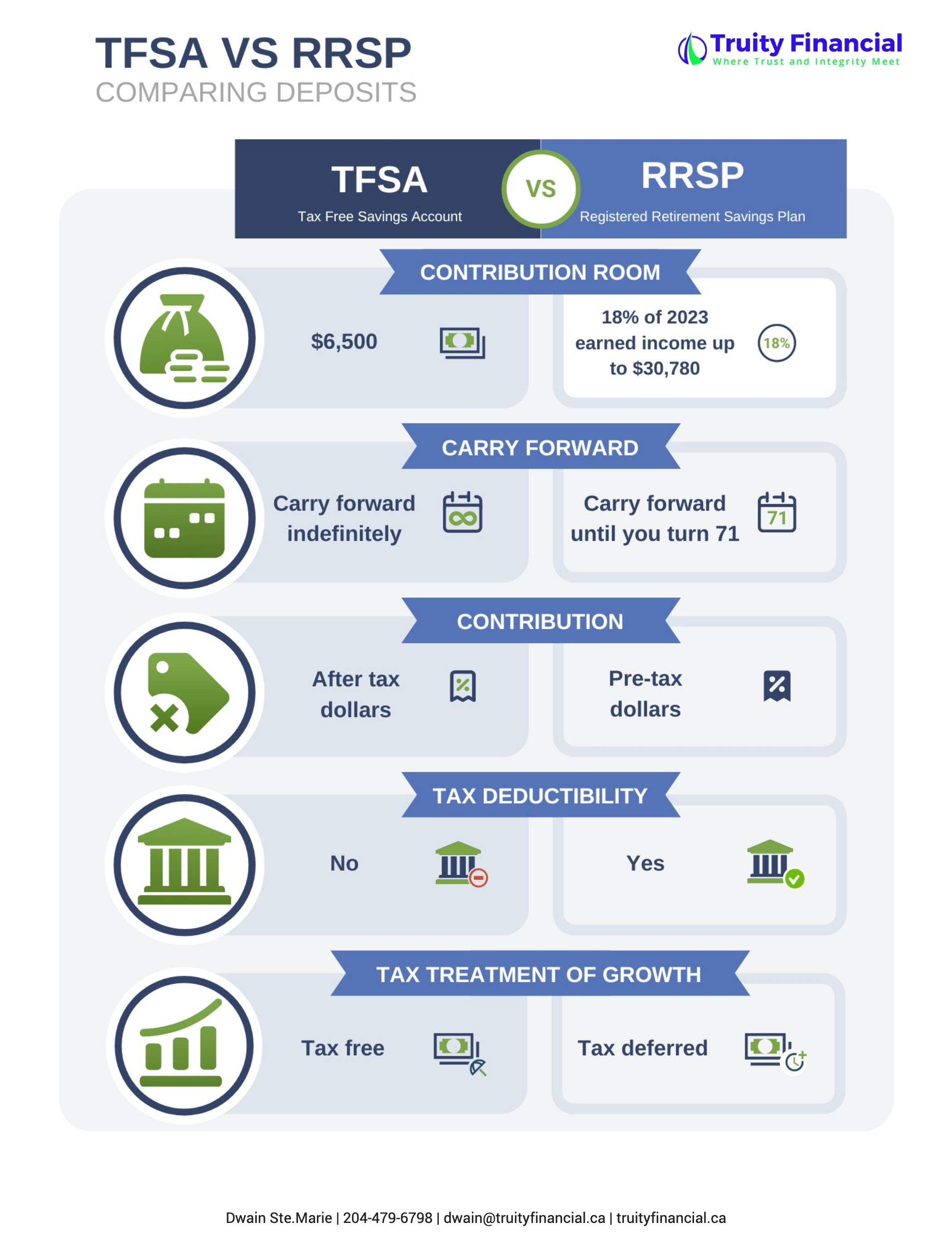
TFSA versus RRSP – Difference in deposits 

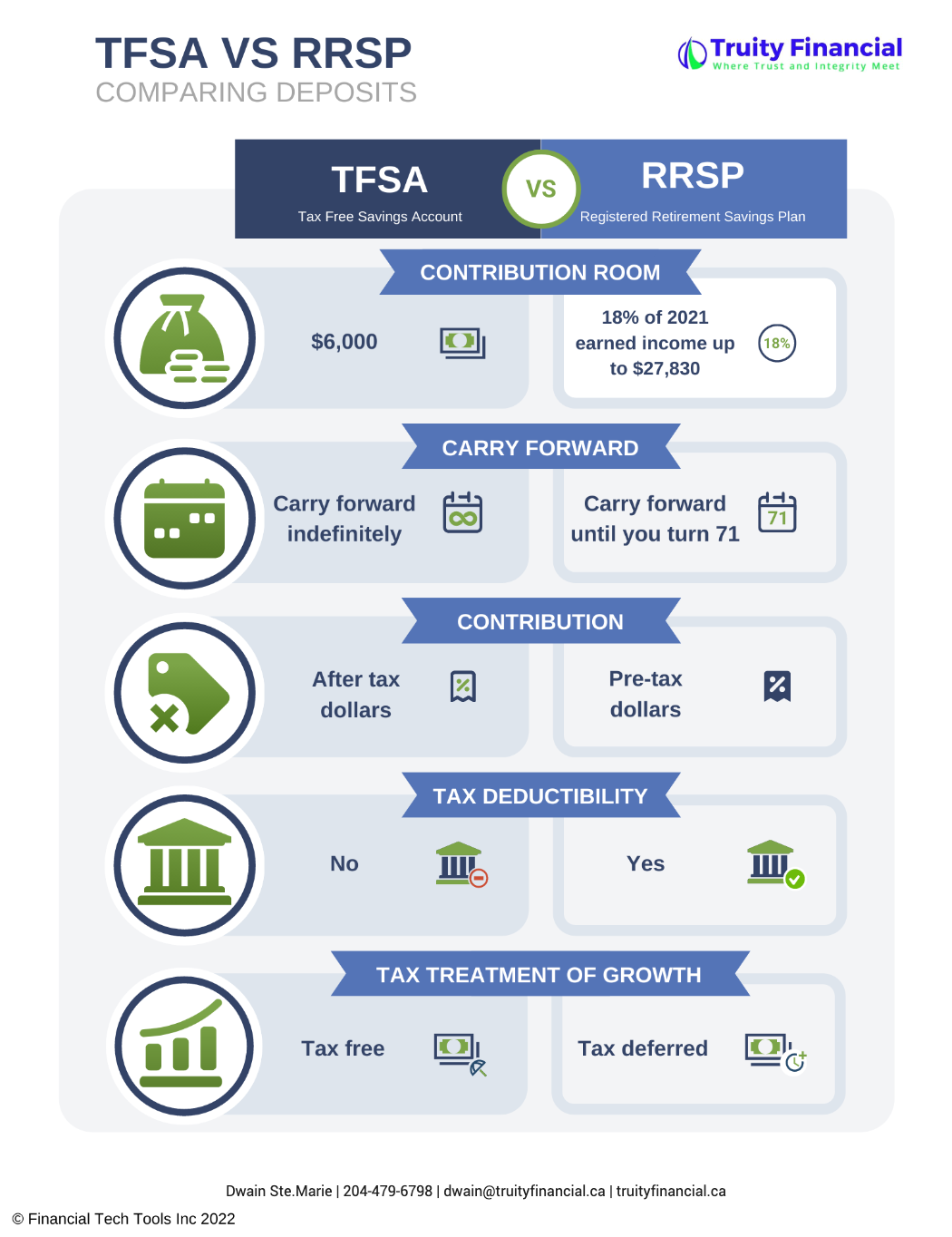
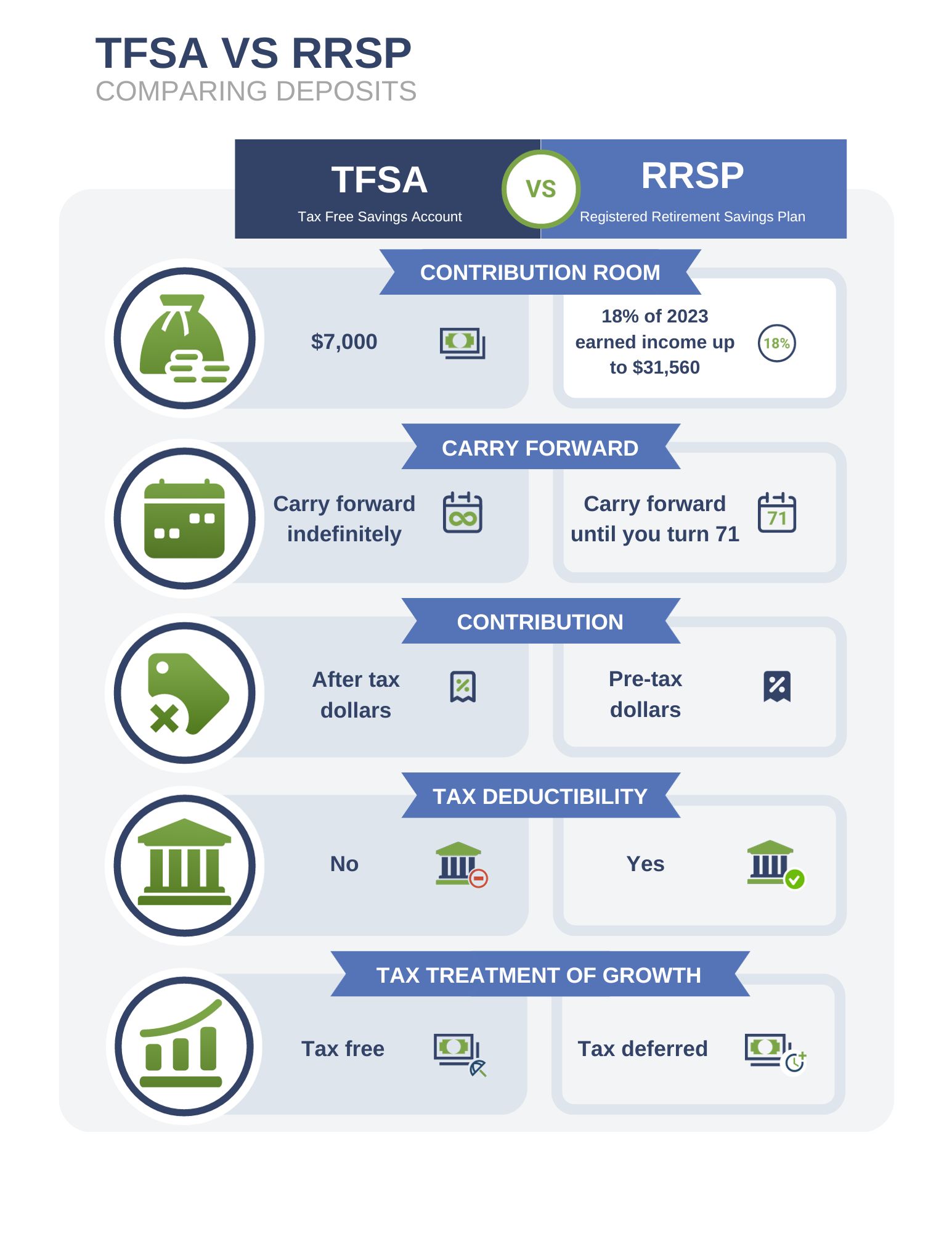
When comparing deposit differences between TFSAs and RRSPs, there are several key considerations: 

  • The amount of contribution room available

  • The ability to carry forward unused contributions

  • The tax deductibility of contributions

  • The tax treatment of growth in the account


How much contribution room do I have? 

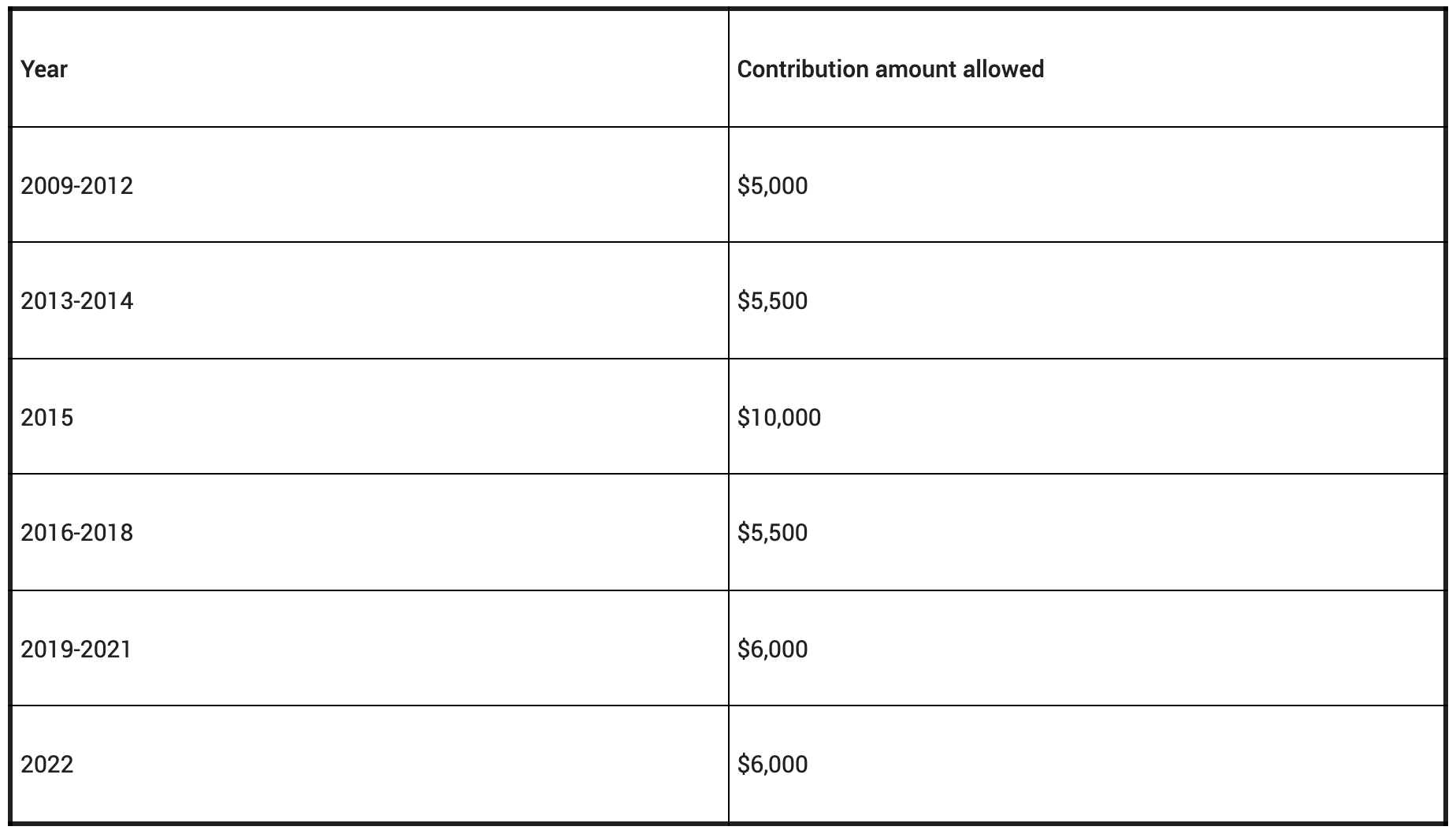
If you have never contributed to a TFSA since 2009, you can contribute up to $102,000 today. This table outlines the contribution amount you are allowed each year since TFSAs were created, including this year: 

Regarding RRSPs, the limit for tax deductions is 18% of your pre-tax earned income from the previous year, with a maximum limit of $32,490. To illustrate, if your pre-tax income in 2024 was $60,000, your deduction limit for 2024 would be $10,800 (18% x $60,000). If your pre-tax income was $200,000, the maximum limit of $32,490 would apply. 

How much contribution room can I carry forward? 

Suppose you opt not to contribute to your TFSA each year or do not contribute the maximum amount. In that case, you can carry forward your unused contribution room indefinitely, provided you are a Canadian resident, over 18 years of age, and have a valid social insurance number. If you make a withdrawal, the amount withdrawn will be added to your annual contribution room for the next calendar year. 

In contrast, for an RRSP, you can carry forward your unused contribution room until age 71. Once you reach 71, you are required to convert your RRSP into an RRIF. Withdrawals from an RRSP do not create additional contribution room.

The tax deductibility of contributions

Your TFSA contributions are not tax-deductible and are made with after-tax dollars. 

Your RRSP contributions are tax-deductible and made with pre-tax dollars. 

Tax Treatment of Growth 

It is essential to contribute to both RRSP and TFSA because of the different tax treatment of the growth within them. 

A TFSA is ideal for short-term goals, such as saving for a down payment on a house or a vacation, as its growth is entirely tax-free. When withdrawing from your TFSA, you will not have to pay any income tax on the amount withdrawn. On the other hand, the growth within an RRSP is tax-deferred. This means you will not pay taxes on your RRSP gains until age 71, at which point you convert the RRSP into an RRIF and start withdrawing money. 

RRSPs are more suitable for long-term goals such as retirement because, in retirement, you will have a lower income and be in a lower tax bracket, resulting in less tax on your RRIF income.

brandableContent

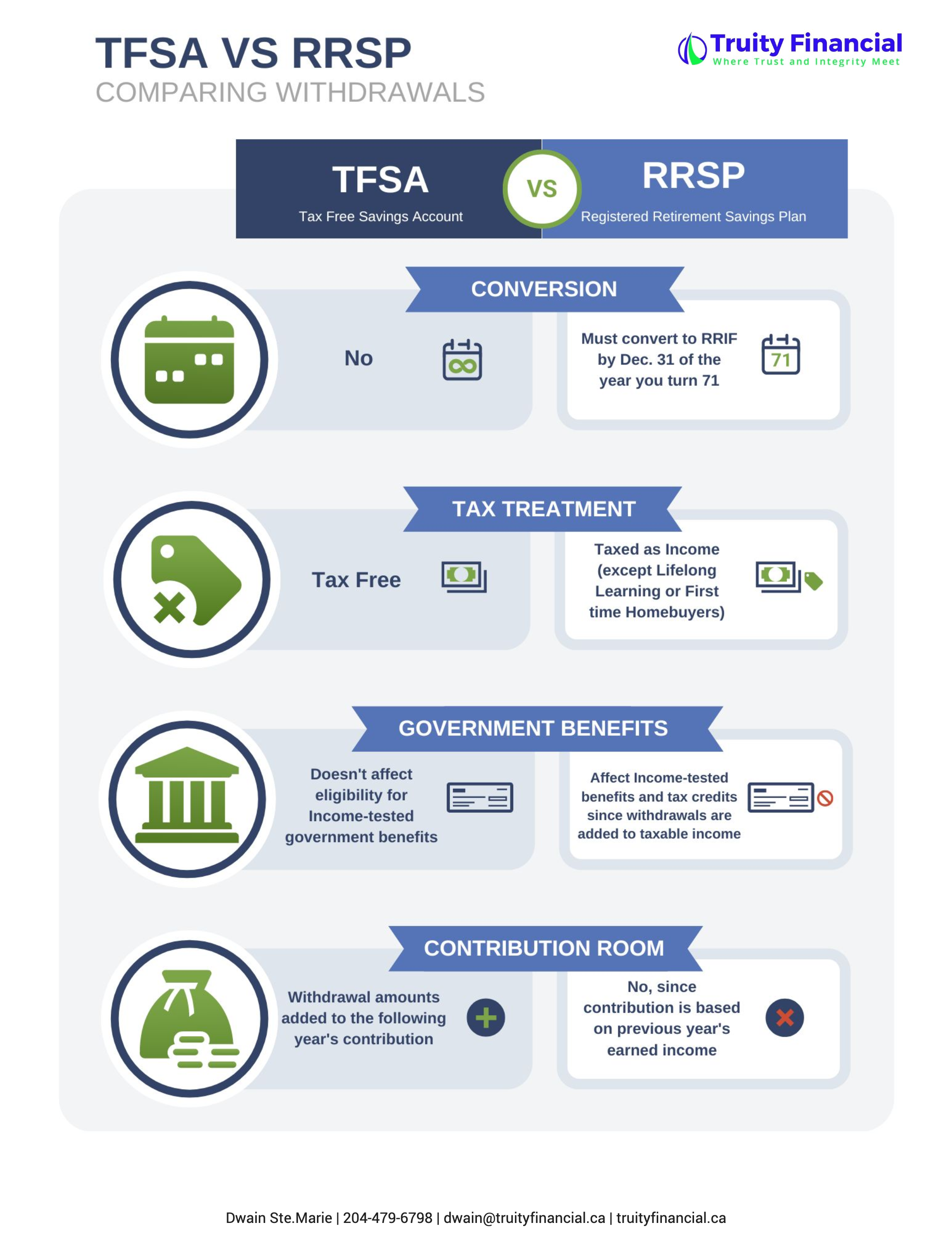
TFSA versus RRSP – Differences in withdrawals 

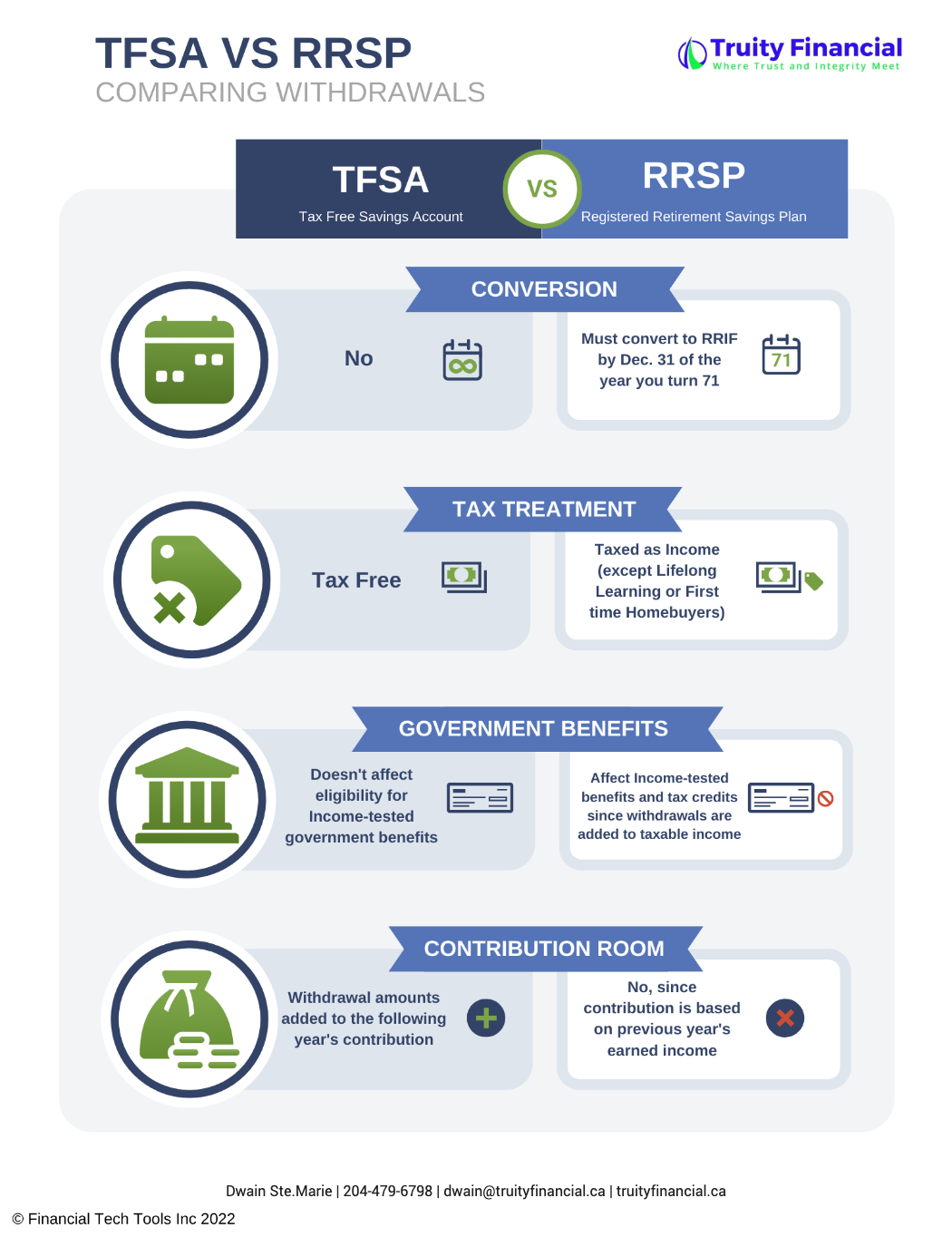
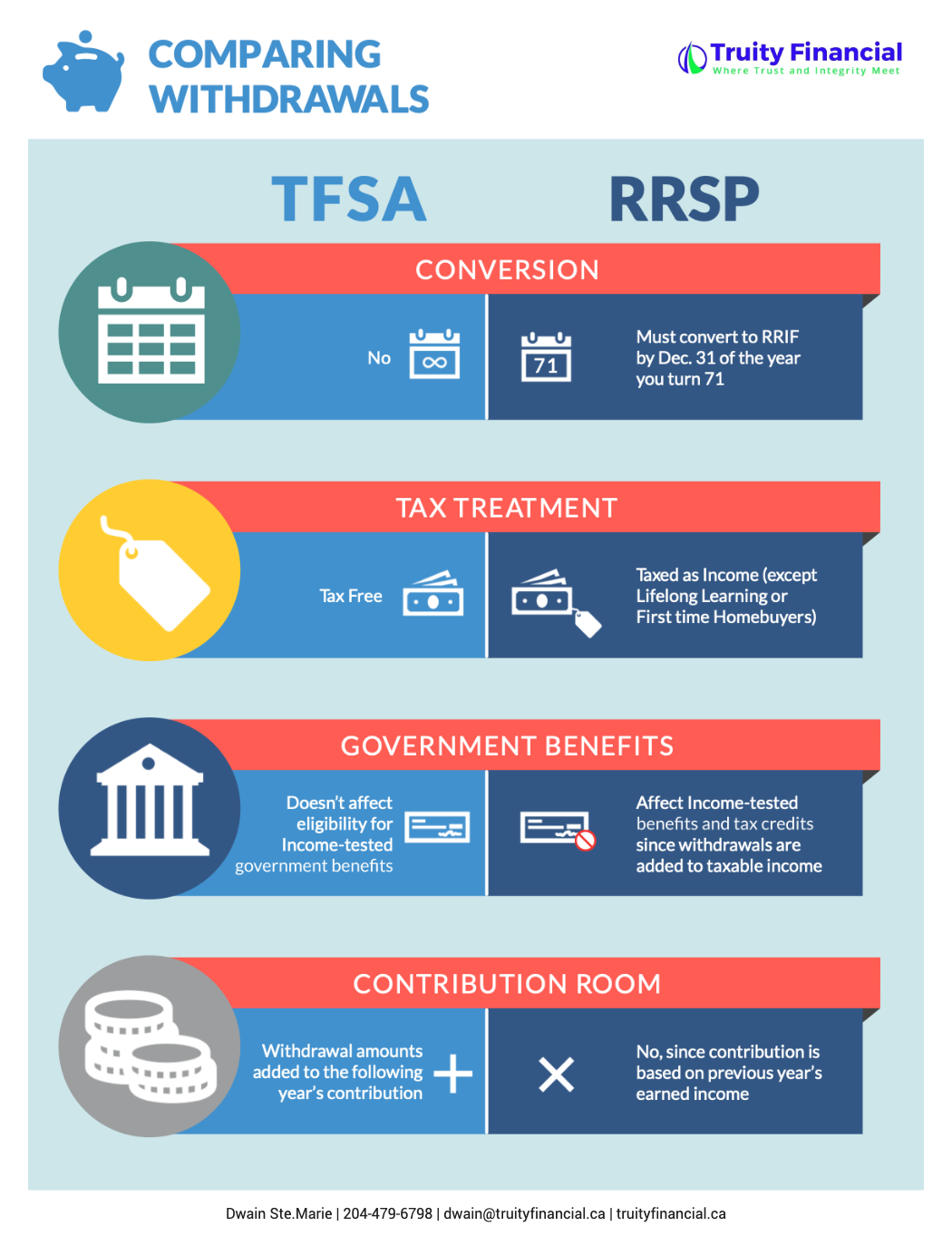
There are several areas to focus on when comparing differences in withdrawal: 

  • Conversion Requirements 

  • Tax Treatment 

  • Government Benefits 

  • Contribution Room 

Conversion Requirements 

For a TFSA, there are never any conversion requirements as there is no maximum age for a TFSA. 

For an RRSP, you must convert it to a Registered Retirement Income Fund (RRIF) if you turn 71 by December 31st, 2025. 

Tax Treatment of Withdrawals 

One of the most attractive things about a TFSA is that all your withdrawals are tax-free! Therefore, they are recommended for short-term goals; you don’t have to worry about taxes when you take money out to pay for a house or a dream vacation. 

With an RRSP, if you make a withdrawal, it will be taxed as income except in two cases: 

  • The Home Buyers Plan lets you withdraw up to $60,000 tax-free, but you must pay it back within fifteen years. 

  • The Lifelong Learning Plan lets you withdraw up to $20,000 ($10,000 maximum per year) tax-free, but you must pay it back within ten years. 

How will my government benefits be impacted? 

If you are withdrawing from your TFSA or RRSP, it’s essential to know how that will affect any benefits you receive from the government. 

Since TFSA withdrawals are not considered taxable income, they will not impact your eligibility for income-tested government benefits. 

RRSP withdrawals are considered taxable income and can affect the following: 

  • Income-tested tax credits such as Canada Child Tax Benefit, the Working Income Tax Benefit, the Goods and Services Tax Credit, and the Age Credit. 

  • Government benefits including Old Age Security, Guaranteed Income Supplement and Employment Insurance. 

How will a withdrawal impact my contribution room? 

If you withdraw from your TFSA, the amount you withdrew will be added on top of your annual contribution room for the following calendar year. If you withdraw from your RRSP, you do not open any additional contribution room. 

The Takeaway 

RRSPs and TFSAs can both be great savings vehicles. However, there are significant differences between them which can affect your finances. If you need help navigating these differences, please do not hesitate to contact us. We’re here to help.

https://truityfinancial.ca/wp-content/uploads/2025/01/TFSA-vs-RRSP-2025.png 300 500 Truity Financial https://truityfinancial.ca/wp-content/uploads/2020/10/truityFinancialLogo.jpg Truity Financial2025-01-31 08:17:162025-01-31 08:17:22TFSA vs RRSP 2025

2025 Financial Calendar

January 1, 2025/in Blog, Family, Financial Planning, personal finances, rrsp, tax, Tax Free Savings Account /by Truity Financial

brandableContent
brandableContent
brandableContent
brandableContent
brandableContent

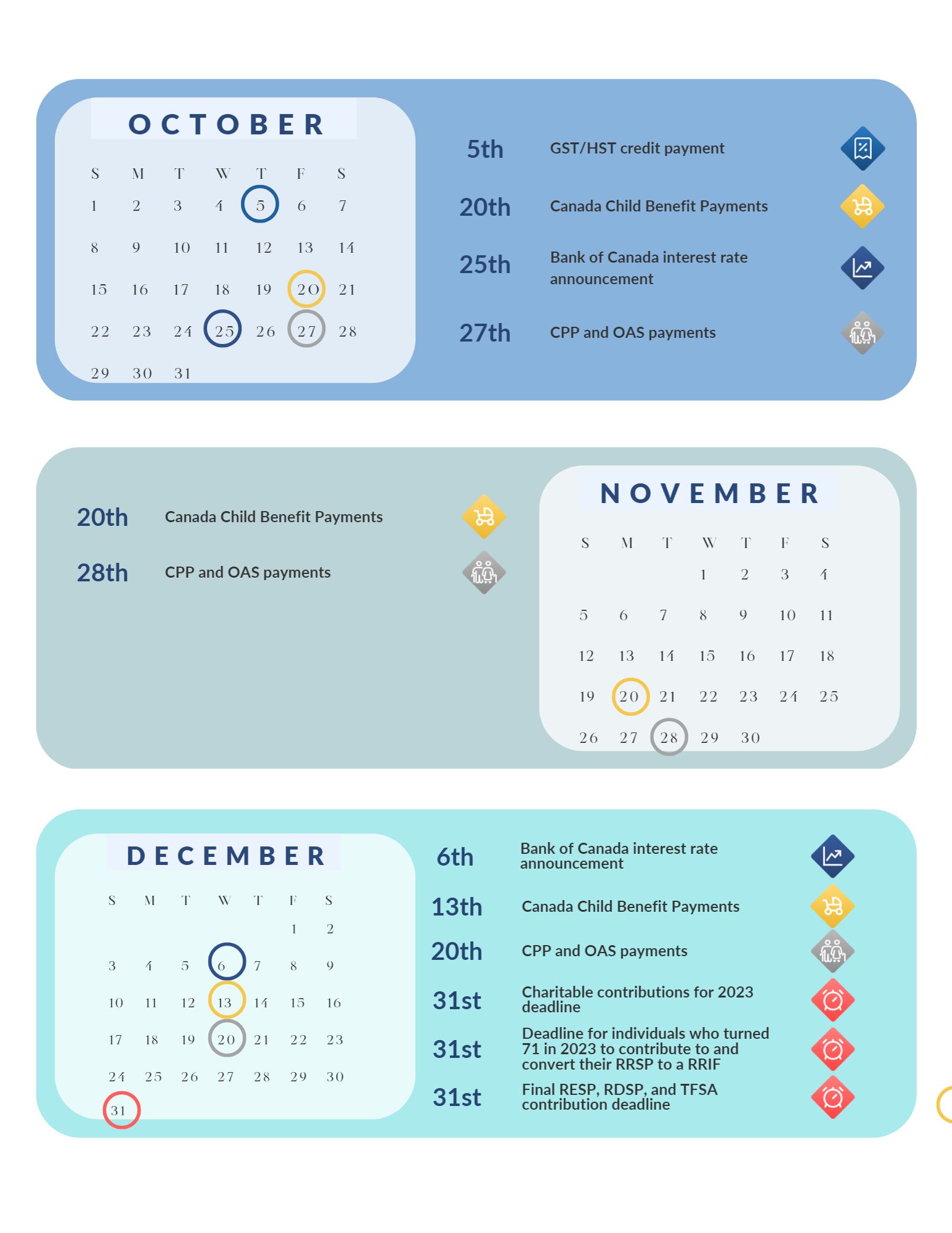
Welcome to our 2025 financial calendar! This calendar is designed to help you keep track of important financial dates and deadlines, such as tax filing and government benefit distribution. You can bookmark this page for easy reference or add these dates to your personal calendar to ensure you don’t miss any important financial obligations.

If you need help with your taxes, tax packages will be available starting February 2024. Don’t wait until the last minute to get started on your tax return – make an appointment with your accountant to ensure you’re ready to go when tax season arrives.

Important 2024 Dates to Know

On January 1, 2025, the contribution room for your Tax-Free Savings Account (TFSA) opens again. For those that are eligible, the contribution rooms for your Registered Retirement Savings Plan (RRSP), First Home Savings Account (FHSA), Registered Education Savings Plan (RESP), and Registered Disability Savings Plan (RDSP) will also be available.

For your Registered Retirement Savings Plan contributions to be eligible for the 2024 income tax year, you must make them by March 3, 2025.

GST/HST credit payments will be issued on:

  • January 3

  • April 4

  • July 4

  • October 3

Canada Child Benefit payments will be issued on the following dates:

  • January 20

  • February 20

  • March 20

  • April 17

  • May 20

  • June 20

  • July 18

  • August 20

  • September 19

  • October 20

  • November 20

  • December 12

The government will issue Canada Pension Plan and Old Age Security payments on the following dates:

  • January 29

  • February 26

  • March 27

  • April 28

  • May 28

  • June 26

  • July 29

  • August 27

  • September 25

  • October 29

  • November 26

  • December 22

The Bank of Canada will make interest rate announcements on:

  • January 29

  • March 12

  • April 16

  • June 4

  • July 30

  • September 17

  • October 29

  • December 10

April 30, 2025, is the last day to file your personal income taxes, and tax payments are due by this date. This is also the filing deadline for final returns if death occurred between January 1 and October 31, 2024.

May 1 to June 30, 2025, would be the filing deadline for final tax returns if death occurred between November 1 and December 31, 2024. The due date for the final return is six months after the date of death.

The tax deadline for all self-employment returns is June 16, 2025. Payments are due April 30, 2025.

The final Tax-Free Savings Account, First Home Savings Account, Registered Education Savings Plan and Registered Disability Savings Plan contributions deadline is December 31, 2025.

December 31, 2025 is also the deadline for 2025 charitable contributions.

December 31, 2025 is also the deadline for individuals who turned 71 in 2025 to finish contributing to their RRSPs and convert them into RRIFs.

Please reach out if you have any questions.


Sources:

https://www.canada.ca/en/revenue-agency/services/tax/individuals/life-events/doing-taxes-someone-died/prepare-returns/filing-deadlines.html

https://www.canada.ca/en/revenue-agency/services/child-family-benefits/benefit-payment-dates.html

https://www.canada.ca/en/revenue-agency/services/tax/individuals/topics/rrsps-related-plans/important-dates-rrsp-rrif-rdsp.html

https://www.canada.ca/en/revenue-agency/news/newsroom/tax-tips/tax-tips-2024/planning-file-your-tax-return-on-paper-here-what-you-need-know.html

https://www.bankofcanada.ca/2024/08/bank-canada-publishes-2025-schedule-policy-interest-rate-announcements-other-major-publications/

https://www.canada.ca/content/dam/cra-arc/camp-promo/smll-bsnss-wk-e.pdf

https://truityfinancial.ca/wp-content/uploads/2025/01/2025-Financial-Calendar.png 280 500 Truity Financial https://truityfinancial.ca/wp-content/uploads/2020/10/truityFinancialLogo.jpg Truity Financial2025-01-01 07:18:522025-01-01 07:18:592025 Financial Calendar

TFSA vs RRSP – 2024

February 1, 2024/in 2024, Blog, business owners, Estate Planning, Family, financial advice, Financial Planning, individuals, Investment, personal finances, Professionals, retirement, rrsp, Tax Free Savings Account /by Truity Financial

Tax-Free Savings Account vs Registered Retirement Savings Plan

When looking to save money in a tax-efficient manner, Tax-Free Savings Accounts (TFSA) and Registered Retirement Savings Plans (RRSP) can offer significant tax benefits. To assist you in understanding the distinctions, we will compare the following:

  • The differences in deposits between TFSAs and RRSPs

  • The differences in withdrawals between TFSAs and RRSPs

TFSA versus RRSP – Difference in deposits 

When comparing deposit differences between TFSAs and RRSPs, there are several key considerations: 

  • The amount of contribution room available

  • The ability to carry forward unused contributions

  • The tax deductibility of contributions

  • The tax treatment of growth in the account


How much contribution room do I have? 

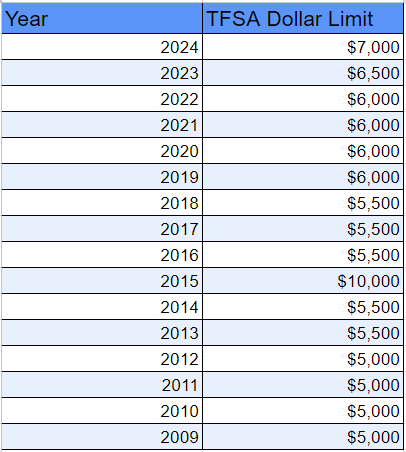
If you have never contributed to a TFSA, you can contribute up to $95,000 today. This table outlines the contribution amount you are allowed each year since TFSAs were created, including this year:
Regarding RRSPs, the limit for tax deductions is 18% of your pre-tax earned income from the previous year, with a maximum limit of $31,560. To illustrate, if your pre-tax income in 2023 was $60,000, your deduction limit for 2024 would be $10,800 (18% x $60,000). If your pre-tax income was $200,000, the maximum limit of $31,560 would apply. 

How much contribution room can I carry forward? 

Suppose you opt not to contribute to your TFSA each year or do not contribute the maximum amount. In that case, you can carry forward your unused contribution room indefinitely, provided you are a Canadian resident, over 18 years of age, and have a valid social insurance number. If you make a withdrawal, the amount withdrawn will be added to your annual contribution room for the next calendar year. 

In contrast, for an RRSP, you can carry forward your unused contribution room until age 71. Once you reach 71, you are required to convert your RRSP into an RRIF. Withdrawals from an RRSP do not create additional contribution room.

The tax deductibility of contributions

Your TFSA contributions are not tax-deductible and are made with after-tax dollars. 

Your RRSP contributions are tax-deductible and made with pre-tax dollars. 

Tax Treatment of Growth 

It is essential to contribute to both RRSP and TFSA because of the different tax treatment of the growth within them. 

A TFSA is ideal for short-term goals, such as saving for a down payment on a house or a vacation, as its growth is entirely tax-free. When withdrawing from your TFSA, you will not have to pay any income tax on the amount withdrawn. On the other hand, the growth within an RRSP is tax-deferred. This means you will not pay taxes on your RRSP gains until age 71, at which point you convert the RRSP into an RRIF and start withdrawing money. 

RRSPs are more suitable for long-term goals such as retirement because, in retirement, you will have a lower income and be in a lower tax bracket, resulting in less tax on your RRIF income.
TFSA versus RRSP – Differences in withdrawals 

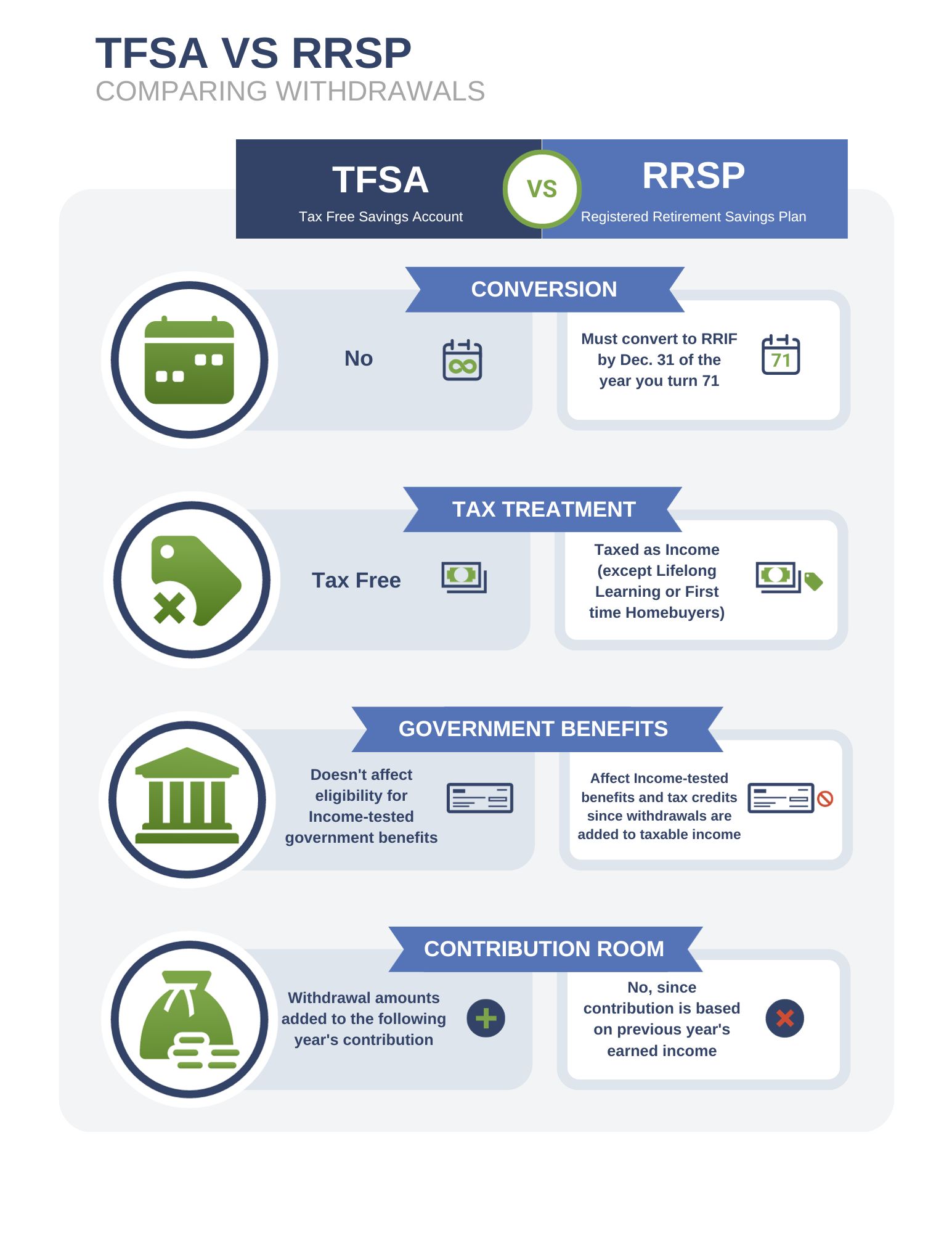
There are several areas to focus on when comparing differences in withdrawal: 

  • Conversion Requirements 

  • Tax Treatment 

  • Government Benefits 

  • Contribution Room 

Conversion Requirements 

For a TFSA, there are never any conversion requirements as there is no maximum age for a TFSA. 

For an RRSP, you must convert it to a Registered Retirement Income Fund (RRIF) if you turn 71 by December 31st, 2024. 

Tax Treatment of Withdrawals 

One of the most attractive things about a TFSA is that all your withdrawals are tax-free! Therefore, they are recommended for short-term goals; you don’t have to worry about taxes when you take money out to pay for a house or a dream vacation. 

With an RRSP, if you make a withdrawal, it will be taxed as income except in two cases: 

  • The Home Buyers Plan lets you withdraw up to $35,000 tax-free, but you must pay it back within fifteen years. 

  • The Lifelong Learning Plan lets you withdraw up to $20,000 ($10,000 maximum per year) tax-free, but you must pay it back within ten years. 

How will my government benefits be impacted? 

If you are withdrawing from your TFSA or RRSP, it’s essential to know how that will affect any benefits you receive from the government. 

Since TFSA withdrawals are not considered taxable income, they will not impact your eligibility for income-tested government benefits. 

RRSP withdrawals are considered taxable income and can affect the following: 

  • Income-tested tax credits such as Canada Child Tax Benefit, the Working Income Tax Benefit, the Goods and Services Tax Credit, and the Age Credit. 

  • Government benefits including Old Age Security, Guaranteed Income Supplement and Employment Insurance. 

How will a withdrawal impact my contribution room? 

If you withdraw from your TFSA, the amount you withdrew will be added on top of your annual contribution room for the following calendar year. If you withdraw from your RRSP, you do not open any additional contribution room. 

The Takeaway 

RRSPs and TFSAs can both be great savings vehicles. However, there are significant differences between them which can affect your finances. If you need help navigating these differences, please do not hesitate to contact us. We’re here to help.
https://truityfinancial.ca/wp-content/uploads/2024/02/TFSA-vs-RRSP-2024.png 300 500 Truity Financial https://truityfinancial.ca/wp-content/uploads/2020/10/truityFinancialLogo.jpg Truity Financial2024-02-01 11:16:232024-02-01 11:16:27TFSA vs RRSP – 2024

TFSA versus RRSP – What you need to know to make the most of them in 2023

February 2, 2023/in 2023, Blog, rrsp, Tax Free Savings Account /by Truity Financial

When looking to save money in a tax-efficient manner, Tax-Free Savings Accounts (TFSA) and Registered Retirement Savings Plans (RRSP) can offer significant tax benefits. To assist you in understanding the distinctions, we will compare the following:

  • The differences in deposits between TFSAs and RRSPs

  • The differences in withdrawals between TFSAs and RRSPs

TFSA versus RRSP – Difference in deposits

When comparing deposit differences between TFSAs and RRSPs, there are several key considerations:

  • The amount of contribution room available

  • The ability to carry forward unused contributions

  • The tax deductibility of contributions

  • The tax treatment of growth in the account

How much contribution room do I have?

If you have never contributed to a TFSA, you can contribute up to $88,000 today. This table outlines the contribution amount you are allowed each year since TFSAs were created, including this year:

   
Year   
   
TFSA dollar limit   
   
2023   
   
$6,500   
   
2022   
   
$6,000   
   
2021   
   
$6,000   
   
2020   
   
$6,000   
   
2019   
   
$6,000   
   
2018   
   
$5,500   
   
2017   
   
$5,500   
   
2016   
   
$5,500   
   
2015   
   
$10,000   
   
2014   
   
$5,500   
   
2013   
   
$5,500   
   
2012   
   
$5,000   
   
2011   
   
$5,000   
   
2010   
   
$5,000   
   
2009   
   
$5,000   

Regarding RRSPs, the limit for tax deductions is 18% of your pre-tax income from the previous year, with a maximum limit of $30,780. To illustrate, if your pre-tax income in 2022 was $60,000, your deduction limit for 2023 would be $10,800 (18% x $60,000). If your pre-tax income was $200,000, the maximum limit of $30,780 would apply.

How much contribution room can I carry forward?

Suppose you opt not to contribute to your TFSA each year or do not contribute the maximum amount. In that case, you can carry forward your unused contribution room indefinitely, provided you are a Canadian resident, over 18 years of age, and have a valid social insurance number. If you make a withdrawal, the amount withdrawn will be added to your annual contribution room for the next calendar year.

In contrast, for an RRSP, you can carry forward your unused contribution room until age 71. Once you reach 71, you are required to convert your RRSP into an RRIF. Withdrawals from an RRSP do not create additional contribution room.

The tax deductibility of contributions

Your TFSA contributions are not tax-deductible and are made with after-tax dollars.

Your RRSP contributions are tax-deductible and made with pre-tax dollars.

Tax Treatment of Growth

It is essential to contribute to both RRSP and TFSA because of the different tax treatment of the growth within them.

A TFSA is ideal for short-term goals, such as saving for a down payment on a house or a vacation, as its growth is entirely tax-free. When withdrawing from your TFSA, you will not have to pay any income tax on the amount withdrawn. On the other hand, the growth within an RRSP is tax-deferred. This means you will not pay taxes on your RRSP gains until age 71, at which point you convert the RRSP into an RRIF and start withdrawing money.

RRSPs are more suitable for long-term goals such as retirement because, in retirement, you will have a lower income and be in a lower tax bracket, resulting in less tax on your RRIF income.

TFSA versus RRSP – Differences in withdrawals

There are several areas to focus on when comparing differences in withdrawal:

  • Conversion Requirements

  • Tax Treatment

  • Government Benefits

  • Contribution Room

Conversion Requirements

For a TFSA, there are never any conversion requirements as there is no maximum age for a TFSA.

For an RRSP, you must convert it to a Registered Retirement Income Fund (RRIF) if you turn 71 by December 31st, 2023.

Tax Treatment of Withdrawals

One of the most attractive things about a TFSA is that all your withdrawals are tax-free! Therefore, they are recommended for short-term goals; you don’t have to worry about taxes when you take money out to pay for a house or a dream vacation.

With an RRSP, if you make a withdrawal, it will be taxed as income except in two cases:

  • The Home Buyers Plan lets you withdraw up to $35,000 tax-free, but you must pay it back within fifteen years.

  • The Lifelong Learning Plan lets you withdraw up to $20,000 ($10,000 maximum per year) tax-free, but you must pay it back within ten years.

How will my government benefits be impacted?

If you are withdrawing from your TFSA or RRSP, it’s essential to know how that will affect any benefits you receive from the government.

Since TFSA withdrawals are not considered taxable income, they will not impact your eligibility for income-tested government benefits.

RRSP withdrawals are considered taxable income and can affect the following:

  • Income-tested tax credits such as Canada Child Tax Benefit, the Working Income Tax Benefit, the Goods and Services Tax Credit, and the Age Credit.

  • Government benefits, including Old Age Security, Guaranteed Income Supplement and Employment Insurance.

How will a withdrawal impact my contribution room?

If you withdraw from your TFSA, the amount you withdrew will be added on top of your annual contribution room for the following calendar year. If you withdraw from your RRSP, you do not open any additional contribution room.

The Takeaway

RRSPs and TFSAs can both be great savings vehicles. However, there are significant differences between them which can affect your finances. If you need help navigating these differences, please do not hesitate to contact us. We’re here to help.
https://truityfinancial.ca/wp-content/uploads/2023/02/TFSA-or-RRSP-2023-Featured-Image-500px.jpeg 292 500 Truity Financial https://truityfinancial.ca/wp-content/uploads/2020/10/truityFinancialLogo.jpg Truity Financial2023-02-02 07:09:072023-02-02 14:11:14TFSA versus RRSP – What you need to know to make the most of them in 2023

2023 Financial Calendar

January 1, 2023/in 2023, Blog, Financial Planning, retirement, rrsp, Tax Free Savings Account /by Truity Financial

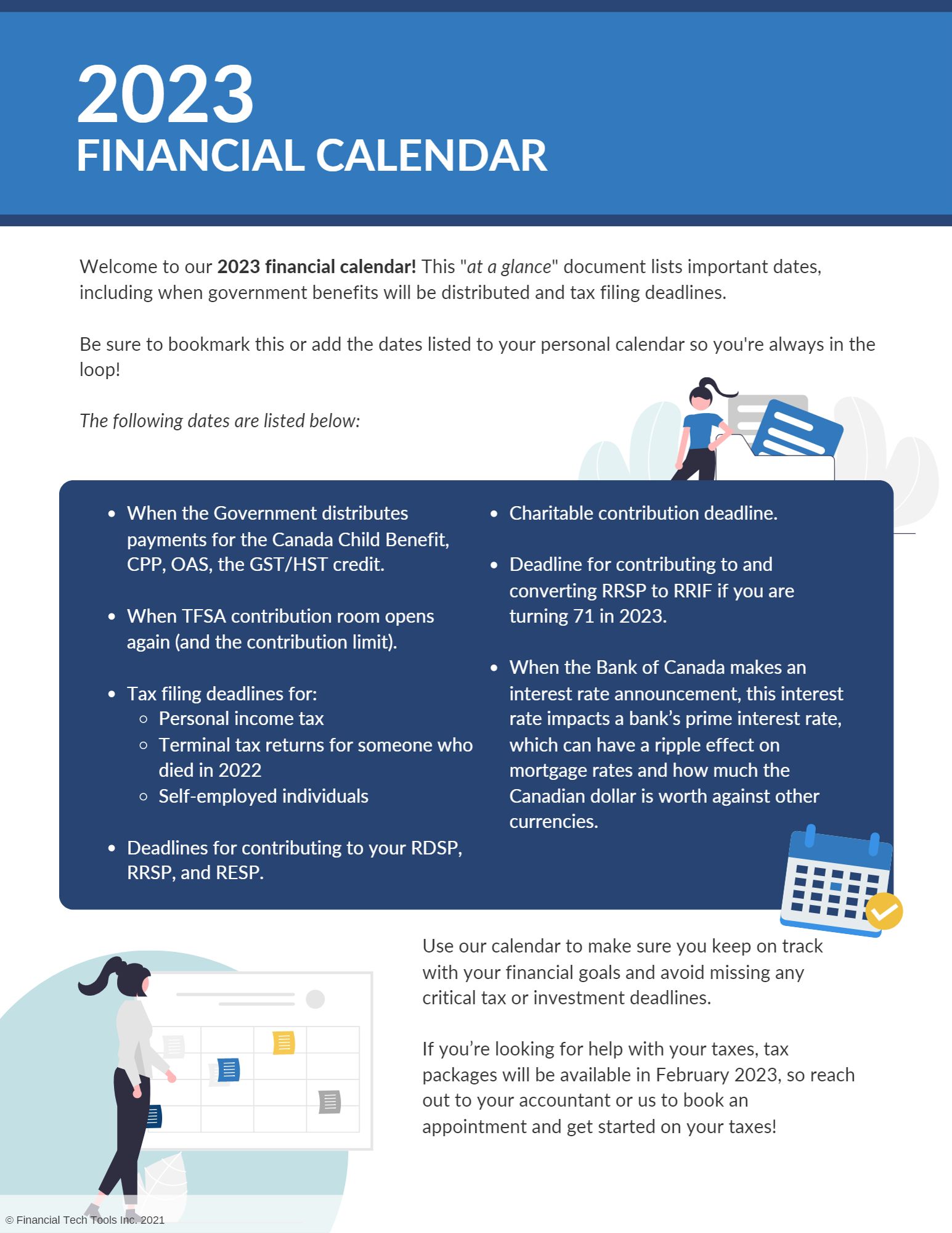
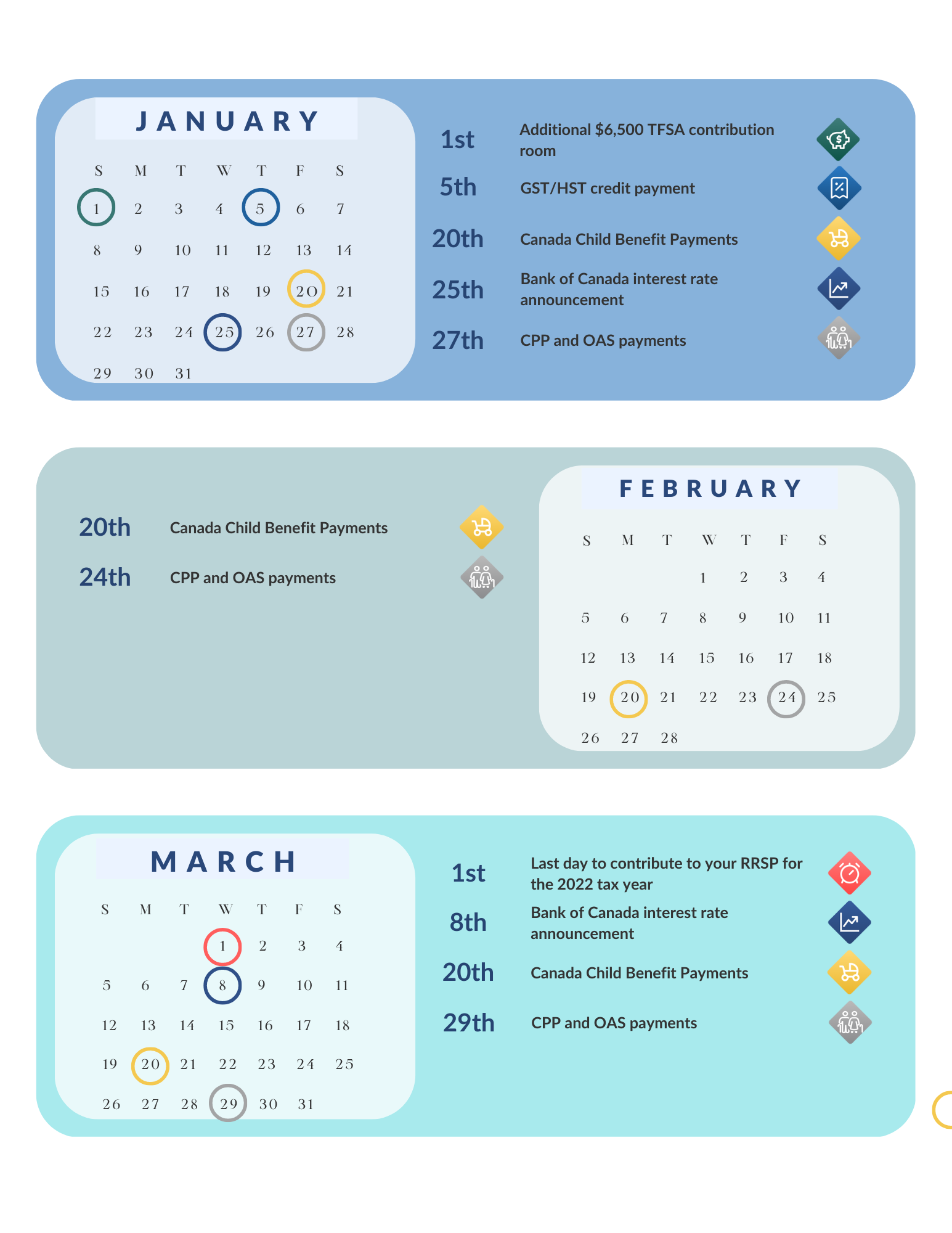
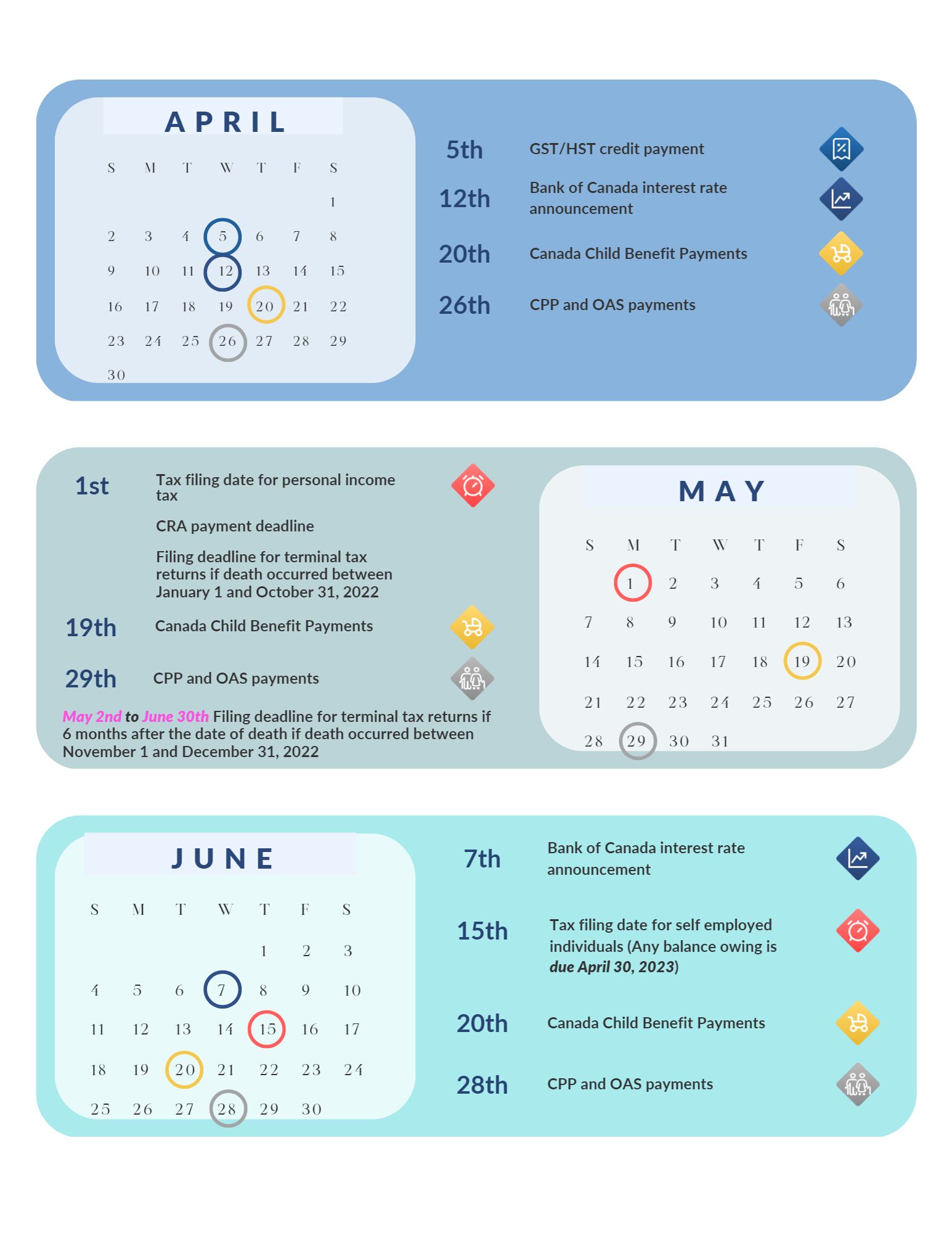
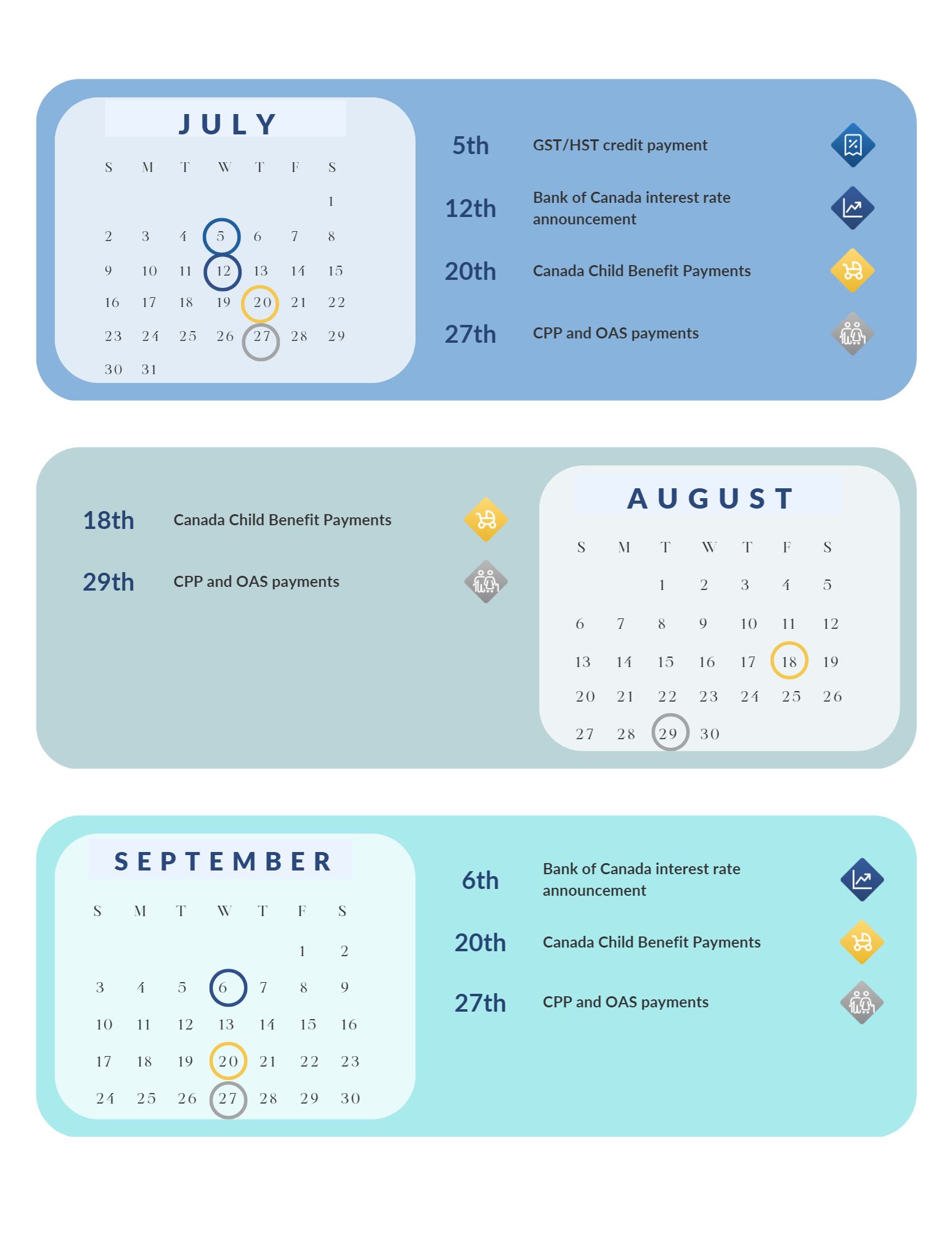
Welcome to our 2023 financial calendar! This calendar is designed to help you keep track of important financial dates and deadlines, such as tax filing and government benefit distribution. You can bookmark this page for easy reference or add these dates to your personal calendar to ensure you don’t miss any important financial obligations.

If you need help with your taxes, tax packages will be available starting February 2023. Don’t wait until the last minute to get started on your tax return – make an appointment with your accountant to ensure you’re ready to go when tax season arrives.

https://truityfinancial.ca/wp-content/uploads/2023/01/2023-Financial-calendar.png 333 500 Truity Financial https://truityfinancial.ca/wp-content/uploads/2020/10/truityFinancialLogo.jpg Truity Financial2023-01-01 07:00:002023-01-03 12:41:482023 Financial Calendar

TFSA versus RRSP – What you need to know to make the most of them in 2022

January 31, 2022/in 2022, Blog, rrsp, Tax Free Savings Account /by Truity Financial

TFSA versus RRSP – What you need to know to make the most of them in 2022

TFSAs and RRSPs can be significant savings vehicles. To help you understand their differences, we have put together this article to compare:

  • TFSA versus RRSP – Differences in deposits

  • TFSA versus RRSP – Differences in withdrawals

TFSA versus RRSP – Difference in deposits

There are four main areas to focus on when comparing differences in deposits for 2022:

  1. Contribution Room

  2. Carry Forward

  3. Contributions and Tax Deductibility

  4. Tax Treatment of Growth

How much contribution room do I have?

If you have never opened a TFSA before, you can contribute up to $81,500 today. This table outlines the contribution amount you are allowed each year since TFSAs were created, including this year:

For RRSPs, the contribution limit is always 18% of your previous year’s pre-tax earnings to a maximum of $29,210. For example, if you earned $60,000 in 2021 then your contribution limit for 2022 would be $10,800 (18% x $60,000). If you earned $200,000, your contribution limit would be capped at the maximum of $29,210.

How much contribution room can I carry forward?

If you choose not to contribute to your TFSA at all one year or do not contribute the maximum amount in a year, you can indefinitely carry forward your unused contribution room. The only restrictions on this are that you must be a Canadian resident, older than 18, and have a valid social insurance number. In addition, if you make a withdrawal, the amount you withdrew is added to your annual contribution room for the following calendar year.

For an RRSP, you can carry forward your unused contribution room until the age of 71. When you turn 71, you must convert your RRSP into an RRIF. If you make a withdrawal from your RRSP, you do not open up any additional contribution room.

Contributions and Tax Deductibility

Your TFSA contributions are not tax-deductible and are made with after-tax dollars. Your RRSP contributions are tax-deductible and are made with pre-tax dollars.

Tax Treatment of Growth

One of the reasons it is essential to make both RRSP and TFSA contributions is that investment value growth is treated differently.

A TFSA is more suitable for short-term objectives like saving for a house down payment or a vacation because the investment value growth is tax-free. In addition, when you make a withdrawal from your TFSA, you will not have to pay income tax on the amount withdrawn.

The growth in an RRSP is tax-deferred, meaning you will not pay any taxes on your RRSP gains until you withdraw money from your future RRIF account; the account you convert your RRSP into at age 71. As a result, RRSPs are better suited for long-term objectives, like retirement. In addition, since you will have a lower income in retirement than when you are working, you will be in a lower tax bracket and not pay much tax on your RRIF income.

TFSA versus RRSP – Differences in withdrawals

There are four main areas to focus on when comparing differences in withdrawal for 2022:

  1. Conversion Requirements

  2. Tax Treatment

  3. Government Benefits

  4. Contribution Room

Conversion Requirements

For a TFSA, there are never any conversion requirements as there is no maximum age for a TFSA. However, if you have an RRSP, you must convert it to a Registered Retirement Income Fund (RRIF) if you turn 71 by December 31st of 2022.

Tax Treatment Of Withdrawals

One of the most attractive things about a TFSA is that all your withdrawals are tax-free! This ability to withdraw funds tax-free is why TFSAs are advantageous for short-term goals; you don’t have to worry about taxes when you take money out to pay for a house or a dream vacation.

With an RRSP, if you make a withdrawal before converting it to a RRIF, it will be taxed as income except in two cases:

  1. The Home Buyers Plan lets you withdraw up to $35,000 tax-free, but you must pay it back within fifteen years.

  2. The Lifelong Learning Plan lets you withdraw up to $20,000 ($10,000 maximum per year) tax-free, but you must pay it back within ten years.

How will my government benefits be impacted?

If you are withdrawing from your TFSA or RRSP, it is essential to know how your withdrawals can impact any benefits you receive from the government.

Since TFSA withdrawals are not considered taxable income, they will not impact your eligibility for income-tested government benefits.

RRSP withdrawals are considered taxable income and can affect the following:

  • Income-tested tax credits such as Canada Child Tax Benefit, the Working Income Tax Benefit, the Goods and Services Tax Credit, and the Age Credit.

  • Government benefits including Old Age Security, Guaranteed Income Supplement and Employment Insurance.

How will a withdrawal impact my contribution room?

If you make a withdrawal from your TFSA, then the amount you withdrew will be added on top of your annual contribution room for the following calendar year. However, if you withdraw money from your RRSP, you do not open up additional contribution room.

The Takeaway

RRSPs and TFSAs can both be great savings vehicles. With this in mind, understanding the differences between these two types of tax-advantaged accounts can help you better plan for future purchases and your eventual retirement.

https://truityfinancial.ca/wp-content/uploads/2022/02/TFSA-vs-RRSP-2022.png 281 500 Truity Financial https://truityfinancial.ca/wp-content/uploads/2020/10/truityFinancialLogo.jpg Truity Financial2022-01-31 08:48:022022-02-01 10:12:14TFSA versus RRSP – What you need to know to make the most of them in 2022

Retirement Planning for Business Owners – Checklist

February 1, 2021/in Blog, Business Owners, corporate, health benefits, life insurance, long term care, pension plan, rrsp, Tax Free Savings Account /by Truity Financial

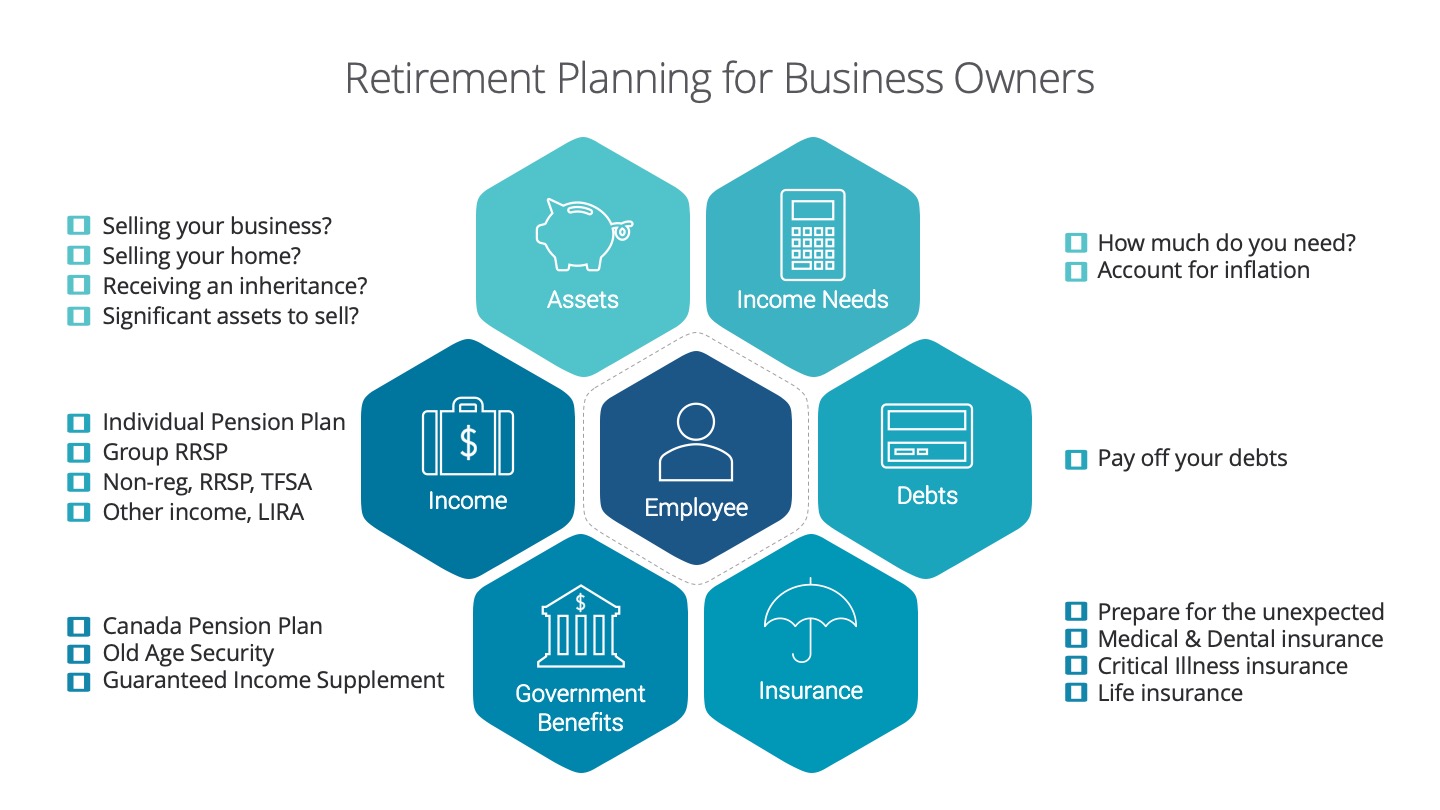
As a business owner, one of your challenges is learning how to balance between reinvesting into the business and setting money aside for personal savings. Since there are no longer employer-sponsored pension plans and the knowledge that retirement will come eventually, it’s important to have a retirement plan in place.

We’ve put together an infographic checklist that can help you get started on this. We know this can be a difficult conversation so we’re here to help and provide guidance to help you achieve your retirement dreams.

Income Needs

  • Determine how much income you will need in retirement.

  • Make sure you account for inflation in your calculations.

Debts

  • You should try to pay off your debts as soon as you can; preferably before you retire.

Insurance

  • As you age, your insurance needs change. Review your insurance needs, in particular your medical and dental insurance because a lot of plans do not provide health plans to retirees.

  • Review your life insurance coverage because you may not necessarily need as much life insurance as when you had dependents and a mortgage, but you may still need to review your estate and final expense needs.

  • Prepare for the unexpected such as a critical illness or a need for long-term care.

Government Benefits

  • Check what benefits are available for you upon retirement.

  • Canada Pension Plan- decide when would be the ideal time to apply and receive CPP payments. Business owners are in a unique position to control how much can be contributed to CPP by deciding to pay salary or dividends. (Dividends don’t trigger CPP contributions.)

  • Old Age Security- check pension amounts and see if there’s a possibility of clawback.

  • Guaranteed Income Supplement- if your income is low enough, you could apply for GIS.

Income

  • Are you a candidate for an individual pension plan (IPP)? IPPs can provide higher contributions than typically permitted to an RRSP and the ability to create a lifelong pension.

  • Check if your business is a candidate for a group RRSP or company pension plan. This is a great way for you to build retirement savings and provide benefits for your employees and business too.

  • Make sure you are saving on a regular basis towards retirement- in an RRSP, TFSA, or non-registered. Since you can control how you get paid, salary or dividends, dividends are not considered eligible income to create RRSP room, therefore you should make sure you have the optimal mix of both to achieve your financial goals.

  • Ensure your investment mix makes sense for your situation.

  • Don’t forget to check if there are any other income sources.  (ex. rental income, side hustle income, etc.)

Assets

  • The sale of your business can be part of your retirement nest egg. Therefore, you should make sure you know the valuation of your business and your plan to sell the business to your family, employees, partners or a third party. You should also know when you decide to sell your business too.

  • Are you planning to use the sale of your home or other assets to fund your retirement?

  • Will you be receiving an inheritance?

One other consideration that’s not included in the checklist is divorce. This can be an uncomfortable question, however divorce amongst adults ages 50 and over is on the rise and this can be financially devastating for both parties.

Next steps…

  • Contact Us about helping you get your retirement planning in order so your retirement dreams can be achieved.

https://truityfinancial.ca/wp-content/uploads/2021/02/retirementPlanningBO.jpeg 810 1440 Truity Financial https://truityfinancial.ca/wp-content/uploads/2020/10/truityFinancialLogo.jpg Truity Financial2021-02-01 06:30:002021-02-01 06:36:19Retirement Planning for Business Owners – Checklist

TFSA vs RRSP – What you need to know to make the most of them in 2021

January 21, 2021/in 2021, Blog, rrsp, Tax Free Savings Account /by Truity Financial

If you are seeking ways to save in the most tax-efficient manner available, TFSAs and RRSPs can provide significant tax savings. To help you understand the differences, we compare:

  1. TFSA versus RRSP – Differences in deposits

  2. TFSA versus RRSP – Differences in withdrawals

1) TFSA versus RRSP – Difference in deposits

There are several areas to focus on when comparing differences in deposits for 2021:

● Contribution Room

● Carry Forward

● Contribution and Tax Deductibility

● Tax Treatment of Growth

How much contribution room do I have?

If you have never contributed to a TFSA before, you can contribute up to $75,500 today. This table outlines the contribution amount you are allowed each year since TFSAs were created, including this year:

For RRSPs, the deduction limit is always 18% of your previous year’s pre-tax earnings to a maximum of $27,830. For example, if you earned $60,000 in 2020 then your deduction limit for 2021 would be $10,800 (18% x $60,000). If you earned $200,000, your deduction limit would be capped at the maximum of $27,830.

How much contribution room can I carry forward?

If you choose not to contribute to your TFSA at all one year or do not contribute the maximum amount in a year, you can indefinitely carry forward your unused contribution room. The only restrictions on this are that you must be a Canadian resident, older than 18, and have a valid social insurance number. If you make a withdrawal, then the amount you withdrew is added on top of your annual contribution room for the next calendar year.

For an RRSP, you can carry forward your unused contribution room until the age of 71. When you turn 71, you must convert your RRSP into an RRIF. If you make a withdrawal from your RRSP, you do not open up any additional contribution room.

Contributions and Tax Deductibility

Your TFSA contributions are not tax-deductible and are made with after-tax dollars.

Your RRSP contributions are tax-deductible and made with pre-tax dollars.

Tax Treatment of Growth

One of the reasons it’s essential to make both RRSP and TFSA contributions is that any growth in them is treated differently.

A TFSA is more suitable for short-term objectives like saving for a house down payment or a vacation – because all of the growth in it is tax-free. When you make a withdrawal from your TFSA, you won’t have to pay income tax on the amount withdrawn.

The growth in an RRSP is tax-deferred. This means you won’t pay any taxes on your RRSP gains until age 71, at which time, you convert RRSP into a RRIF and begin withdrawing money. RRSPs are better suited for long-term objectives, like retirement. Since you will have a lower income in retirement than when you are working, you will be in a lower tax bracket and, thus, not pay as much tax on your RRIF income.

TFSA versus RRSP – Differences in withdrawals

There are several areas to focus on when comparing differences in withdrawal for 2021:

  • Conversion Requirements

  • Tax Treatment

  • Government Benefits

  • Contribution Room

Conversion Requirements

For a TFSA, there are never any conversion requirements as there is no maximum age for a TFSA.

For an RRSP, you must convert it to a Registered Retirement Income Fund (RRIF) if you turn 71 by December 31st of 2021.

Tax Treatment of withdrawals

One of the most attractive things about a TFSA is that all your withdrawals are tax-free! This is why they are recommended for short-term goals; you don’t have to worry about taxes when you take money out to pay for a house or a dream vacation.

With an RRSP, if you make a withdrawal, it will be taxed as income except in two cases:

  • The Home Buyers Plan lets you withdraw up to $35,000 tax-free, but you must pay it back within fifteen years.

  • The Lifelong Learning Plan lets you withdraw up to $20,000 ($10,000 maximum per year) tax-free, but you must pay it back within ten years.

How will my government benefits be impacted?

If you are making a withdrawal from your TFSA or RRSP, it’s essential to know how that will affect any benefits you receive from the government.

Since TFSA withdrawals are not considered taxable income, they will not impact your eligibility for income-tested government benefits.

RRSP withdrawals are considered taxable income and can affect the following:

  • Income-tested tax credits such as Canada Child Tax Benefit, the Working Income Tax Benefit, the Goods and Services Tax Credit, and the Age Credit.

  • Government benefits including Old Age Security, Guaranteed Income Supplement and Employment Insurance.

How will a withdrawal impact my contribution room?

If you make a withdrawal from your TFSA, then the amount you withdrew will be added on top of your annual contribution room for the next calendar year. If you make a withdrawal from your RRSP, you do not open up any additional contribution room.

The Takeaway

RRSPs and TFSAs can both be great savings vehicles. However, there are significant differences between them which can affect your finances. If you need help navigating these differences, please do not hesitate to contact us. We’re here to help.

https://truityfinancial.ca/wp-content/uploads/2021/01/TFSA_vs_RRSP_2021_Featured_Image.png 281 500 Truity Financial https://truityfinancial.ca/wp-content/uploads/2020/10/truityFinancialLogo.jpg Truity Financial2021-01-21 14:01:102021-01-21 14:33:26TFSA vs RRSP – What you need to know to make the most of them in 2021

2021 Financial Calendar

January 4, 2021/in 2021, Blog, personal finances, rdsp, Registered Education Savings Plan, retirement, rrsp, tax, Tax Free Savings Account /by Truity Financial

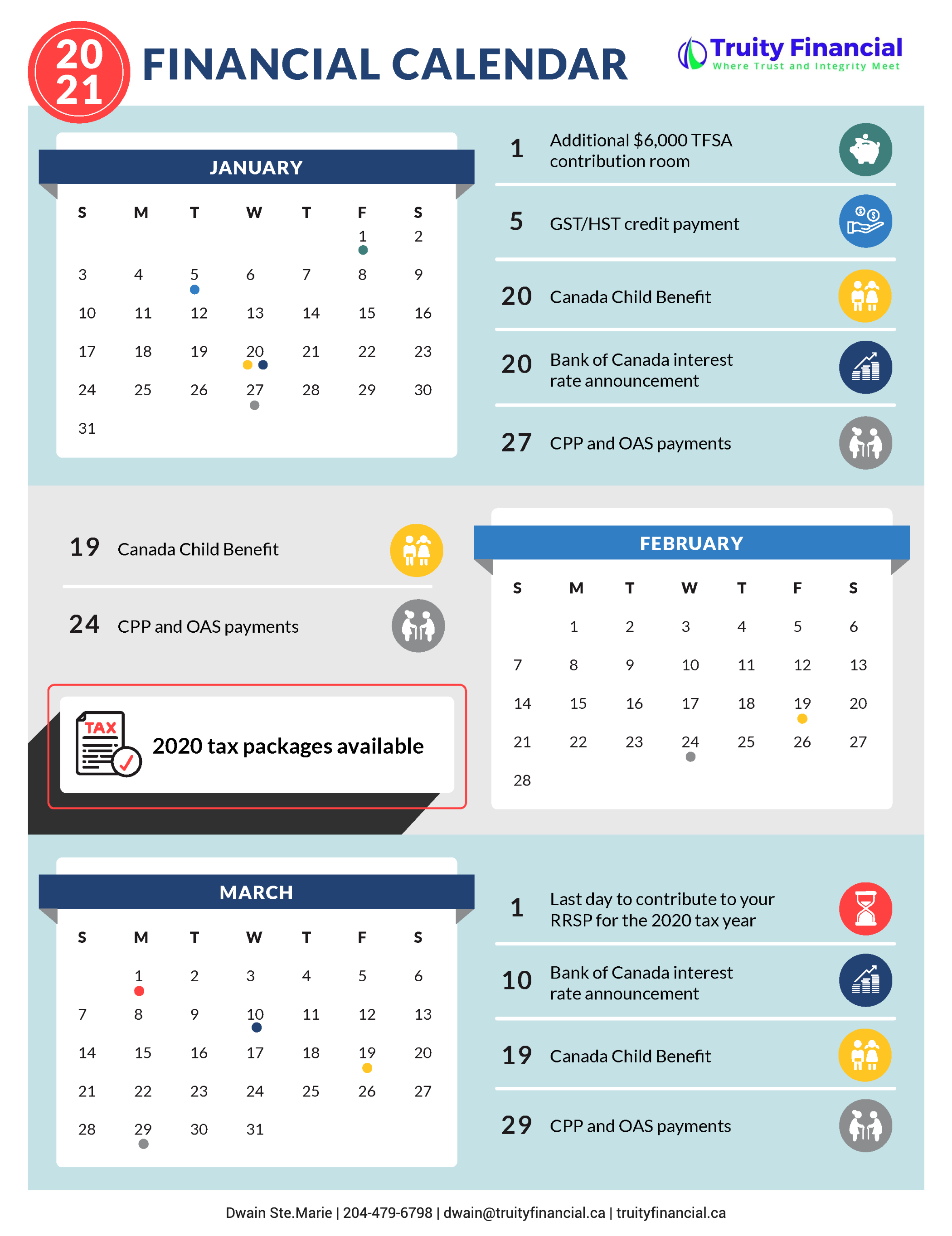
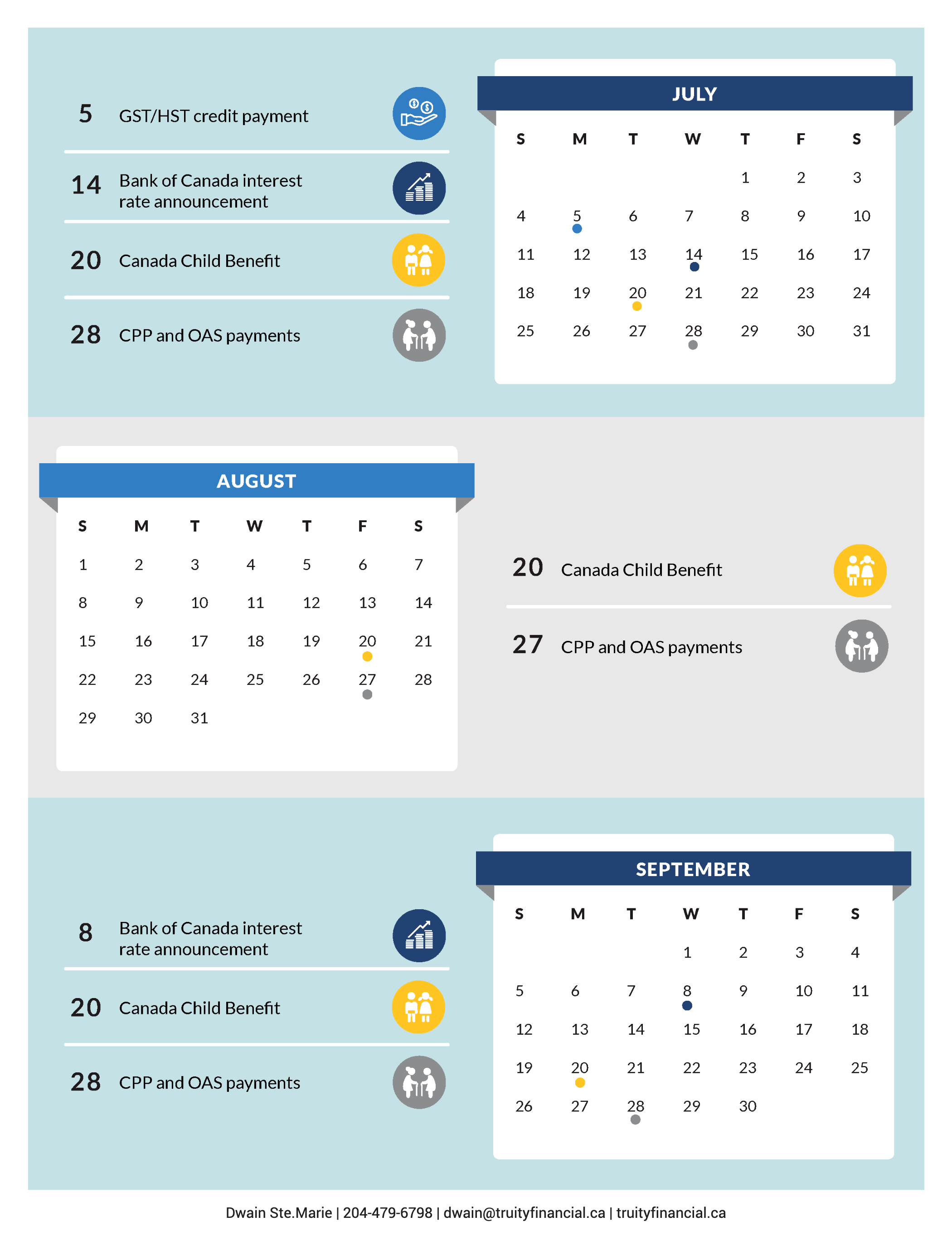
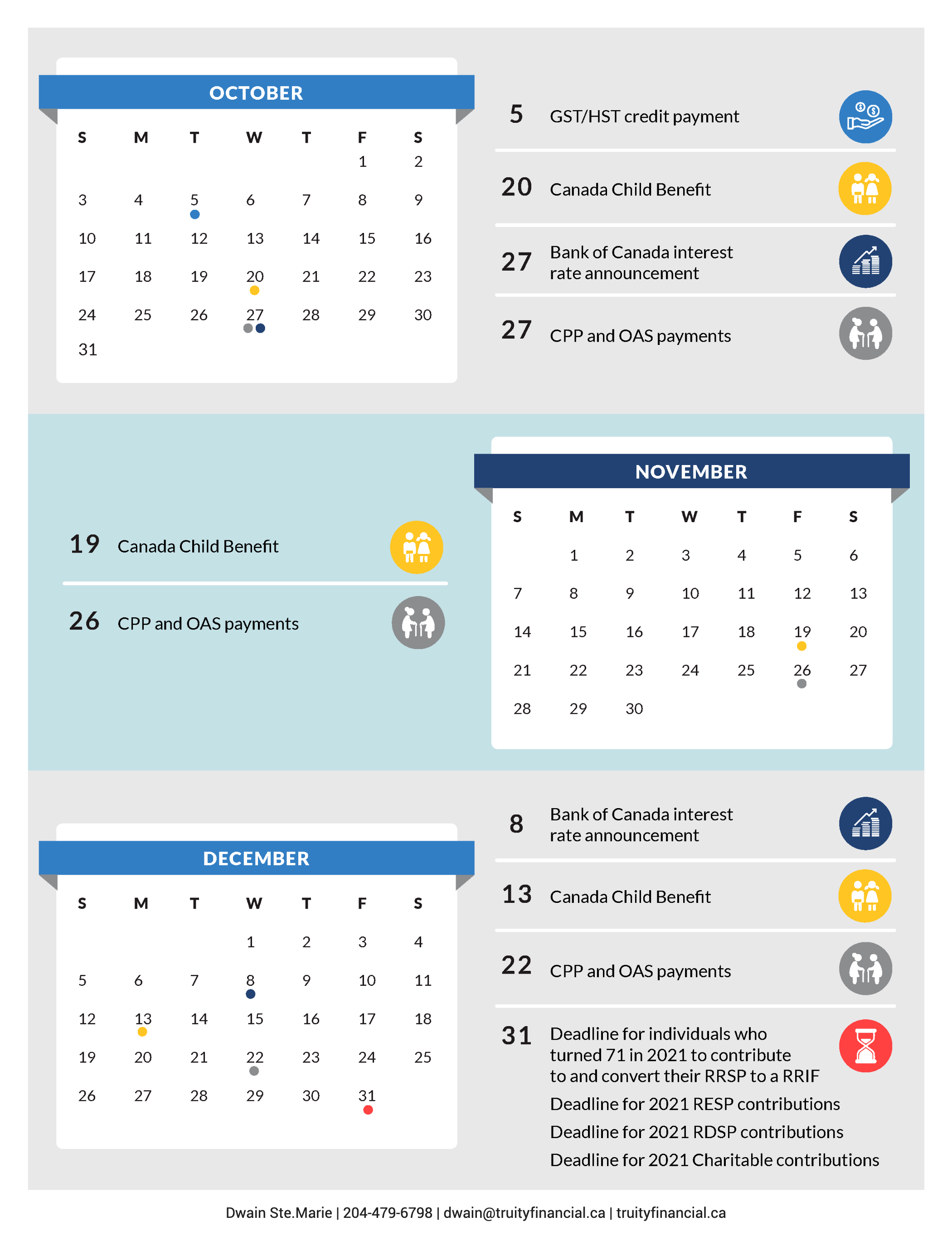
We’ve put together a financial calendar for 2021. It contains all the dates you need to know to make the most of your government benefits and investment options. Whether you want to bookmark this or print it out and post it somewhere prominent, you’ll have everything you need to know in one place!

We’ve provided information on:

  • The dates when the government distributes payments for the Canada Child Benefit, the Canada Pension Plan (CPP) and Old Age Security (OAS).

  • When GST/HST credit payments are issued – usually on the fifth day of January, April, July and October.

  • All the dates the Bank of Canada makes an interest rate announcement. A change in this interest rate (up or down) can impact a bank’s prime interest rates. This can then affect anything from the interest rate charged on your mortgage and line of credit to how much the Canadian dollar is worth against other currencies.

  • When you can start contributing to your Tax Free Savings Account (TFSA) for 2021, the contribution limit for 2021 is $6,000.

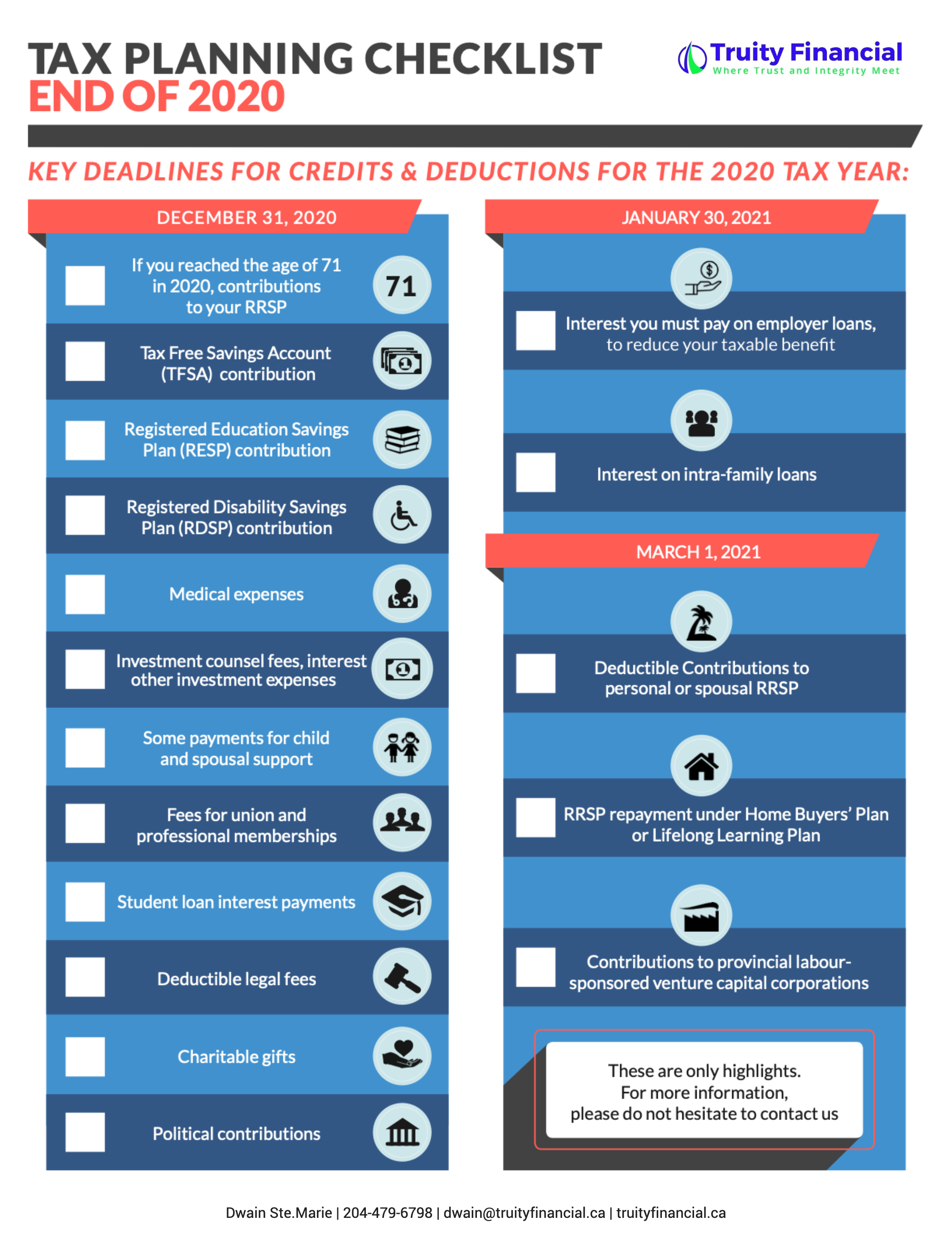
  • March 1st is the last day for your 2020 Registered Retirement Savings Plan (RRSP).

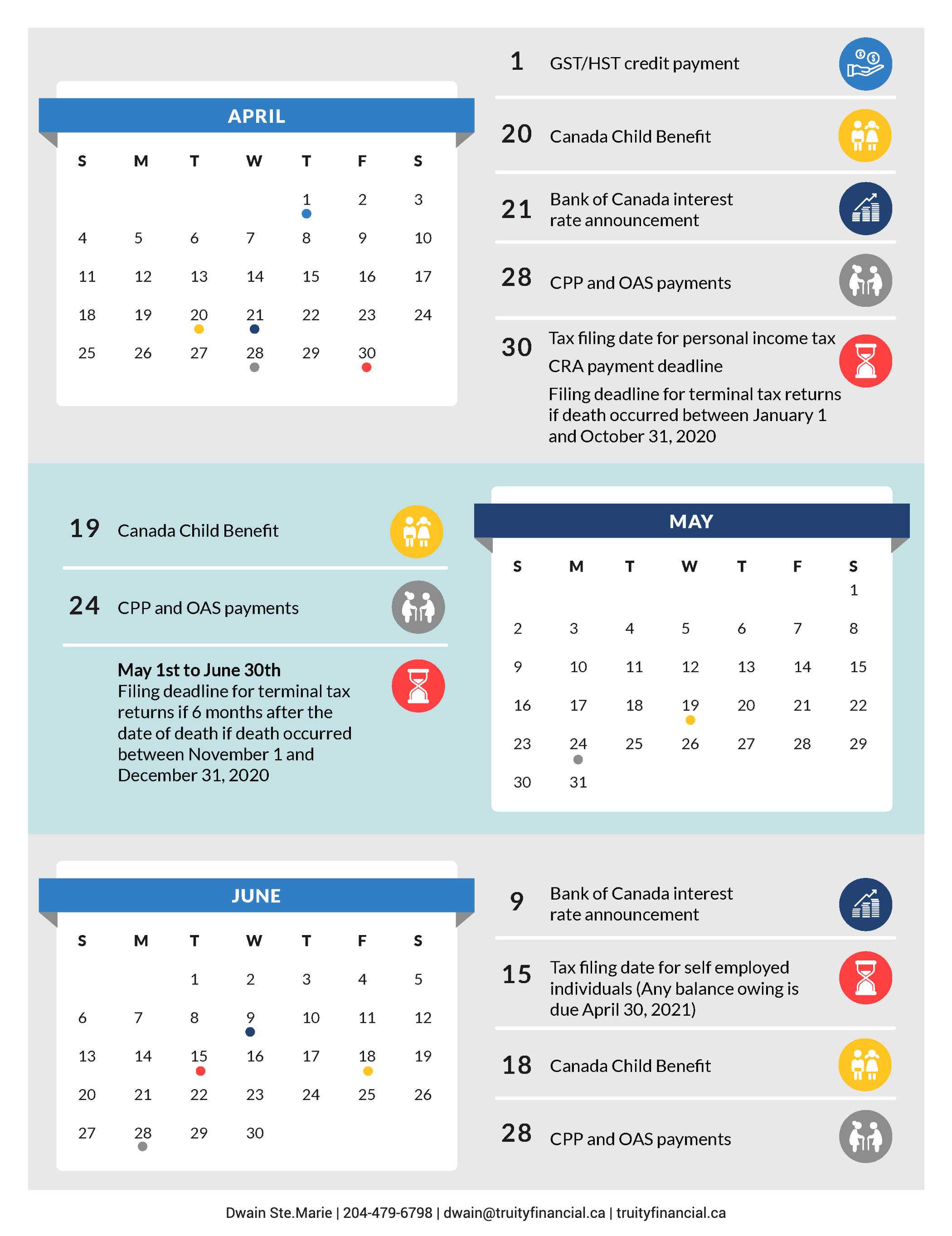
  • December 31st , 2021 is the last day for 2021 charitable contributions.

  • December 31st is the deadlines for various investment savings vehicle contributions, including your Registered Disability Savings Plan (RDSP) and Registered Education Savings Plan (RESP), as well as your RRSP if you turned 71 in 2021.

  • Tax filing deadlines for personal income tax, terminal tax returns for someone who died in 2020, self-employed individuals

Knowing all of this information here can help you keep on top of your finances if you’re expecting any government benefits. It can also make sure you don’t miss any critical tax or investment deadlines!

Tax packages will be available starting February 2021 – reach out to your accountant to get started on your taxes!

If you have any questions on how we can help with your 2021 finances, please contact us.

https://truityfinancial.ca/wp-content/uploads/2021/01/2021-FInancial-calendar-1.png 563 1000 Truity Financial https://truityfinancial.ca/wp-content/uploads/2020/10/truityFinancialLogo.jpg Truity Financial2021-01-04 06:00:002021-01-04 06:15:532021 Financial Calendar
Page 1 of 212

Search Blog Posts

Latest News

  • 2025 Year-End Tax Tips and Strategies for Business OwnersDecember 2, 2025 - 12:16 pm
  • 2025 Personal Year End Tax TipsDecember 2, 2025 - 11:53 am
  • 2025 Federal Budget HighlightsNovember 5, 2025 - 11:34 am

Get in Touch

Truity Financial
Dwain Ste.Marie, CFP
Financial Advisor
T: 204-479-6798
E: dwain@truityfinancial.ca

850-330 St. Mary Avenue
Winnipeg, MB
R3C 3Z5

Latest News

  • 2025 Year-End Tax Tips and Strategies for Business OwnersDecember 2, 2025 - 12:16 pm
  • 2025 Personal Year End Tax TipsDecember 2, 2025 - 11:53 am
  • 2025 Federal Budget HighlightsNovember 5, 2025 - 11:34 am

About

Our goal is to help our clients make the best-informed decisions about their finances in a complex tax world.  Trust and integrity are the cornerstones of Truity Financial.

©2020 Financial Tech Tools Inc. | Privacy Statement and Terms of Use
  • LinkedIn
  • Twitter
  • Facebook
Scroll to top